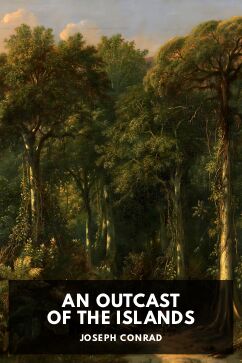
An Outcast of the Islands - Joseph Conrad

(9 User reviews)   1839
By Nicholas Ortiz Posted on Jan 27, 2026
In Category - Justice Studies
Joseph Conrad Joseph Conrad
English
Okay, so picture this: a guy who thinks he's a big shot trader in Southeast Asia gets caught red-handed in a stupid, petty theft. His reputation is instantly toast, and he's banished to this remote, swampy trading post in the middle of nowhere. It's basically his last chance. But instead of keeping his head down and rebuilding, he meets a local woman, Aïssa, and becomes completely obsessed. This obsession makes him throw away every shred of logic, loyalty, and self-preservation he has left. 'An Outcast of the Islands' is about watching a man actively choose his own destruction, step by terrible step, all because he can't see past his own desires. Conrad doesn't give you heroes; he gives you deeply flawed people making awful choices in a setting that feels both beautiful and suffocating. It's a masterclass in psychological unraveling.
Share

Read "An Outcast of the Islands - Joseph Conrad" Online

This book is available in the public domain. Start reading the digital edition below.

START READING FULL BOOK
Instant Access    Mobile Friendly

Book Preview

A short preview of the book’s content is shown below to give you an idea of its style and themes.

“Almayer’s Folly,” was whether I should write another line for print. Those days, now grown so dim, had their poignant moments. Neither in my mind nor in my heart had I then given up the sea. In truth I was clinging to it desperately, all the more desperately because, against my will, I could not help feeling that there was something changed in my relation to it. “Almayer’s Folly,” had been finished and done with. The mood itself was gone. But it had left the memory of an experience that, both in thought and emotion was unconnected with the sea, and I suppose that part of my moral being which is rooted in consistency was badly shaken. I was a victim of contrary stresses which produced a state of immobility. I gave myself up to indolence. Since it was impossible for me to face both ways I had elected to face nothing. The discovery of new values in life is a very chaotic experience; there is a tremendous amount of jostling and confusion and a momentary feeling of darkness. I let my spirit float supine over that chaos. A phrase of Edward Garnett’s is, as a matter of fact, responsible for this book. The first of the friends I made for myself by my pen it was but natural that he should be the recipient, at that time, of my confidences. One evening when we had dined together and he had listened to the account of my perplexities (I fear he must have been growing a little tired of them) he pointed out that there was no need to determine my future absolutely. Then he added: “You have the style, you have the temperament; why not write another?” I believe that as far as one man may wish to influence another man’s life Edward Garnett had a great desire that I should go on writing. At that time, and I may say, ever afterwards, he was always very patient and gentle with me. What strikes me most however in the phrase quoted above which was offered to me in a tone of detachment is not its gentleness but its effective wisdom. Had he said, “Why not go on writing,” it is very probable he would have scared me away from pen and ink for ever; but there was nothing either to frighten one or arouse one’s antagonism in the mere suggestion to “write another.” And thus a dead point in the revolution of my affairs was insidiously got over. The word “another” did it. At about eleven o’clock of a nice London night, Edward and I walked along interminable streets talking of many things, and I remember that on getting home I sat down and wrote about half a page of “An Outcast of the Islands” before I slept. This was committing myself definitely, I won’t say to another life, but to another book. There is apparently something in my character which will not allow me to abandon for good any piece of work I have begun. I have laid aside many beginnings. I have laid them aside with sorrow, with disgust, with rage, with melancholy and even with self-contempt; but even at the worst I had an uneasy consciousness that I would have to go back to them. “An Outcast of the Islands” belongs to those novels of mine that were never laid aside; and though it brought me the qualification of “exotic writer” I don’t think the charge was at all justified. For the life of me I don’t see that there is the slightest exotic spirit in...

This is a limited preview. Download the book to read the full content.

Joseph Conrad's second novel takes us deep into the Malay Archipelago, but the real jungle here is the human heart. It's a prequel of sorts to 'Almayer's Folly,' but you absolutely don't need to have read that to get swept up in this story.

The Story

We follow Peter Willems, a man who has built a comfortable life as a clerk for a powerful trading company. He's respected, or so he thinks. When he's caught stealing from his own boss, the legendary Captain Lingard, his world collapses. As a final act of pity, Lingard exiles him to a remote outpost called Sambir, run by his other protégé, Almayer. Willems is supposed to lay low and maybe find some redemption. Instead, he becomes infatuated with Aïssa, the daughter of a local chief. This obsession consumes him. To possess her, he betrays Lingard's trust in the worst way possible, revealing secret trading routes to a scheming Arab merchant. Every decision Willems makes from this point on digs him deeper into a hole of his own making, alienating everyone who could have helped him and sealing his fate as a true outcast.

Why You Should Read It

This book gripped me because it's such an honest, brutal look at self-deception. Willems isn't evil; he's weak and selfish, and he spends the whole book convincing himself he's the victim. Conrad doesn't judge him outright—he just puts his choices on display, and the consequences are devastatingly clear. The setting is a character itself: the oppressive heat, the slow, muddy river, and the dense jungle mirror the moral stagnation and trapped feeling of the characters. You feel the claustrophobia. It's a story about the lies we tell ourselves to justify what we want, and how those lies can utterly destroy us.

Final Verdict

This is a book for readers who love complex, unlikable characters and aren't afraid of a bleak, psychologically intense journey. If you enjoy stories about moral ambiguity and the slow burn of a personal downfall, you'll find this incredibly rewarding. It's not a light, adventure-filled romp; it's a heavy, thoughtful, and utterly captivating portrait of a man choosing his own ruin. Perfect for fans of classic literary fiction that sticks with you long after the last page.


✅ Free to Use

This text is dedicated to the public domain. Thank you for supporting open literature.

Joshua Ramirez
1 year ago

A bit long but worth it.

Kimberly Lopez
6 months ago

Essential reading for students of this field.

William Brown
1 year ago

After hearing about this author multiple times, it manages to explain difficult concepts in plain English. Thanks for sharing this review.

Amanda Martinez
1 year ago

I have to admit, the author's voice is distinct and makes complex topics easy to digest. Worth every second.

5
5 out of 5 (9 User reviews )

Add a Review

Your Rating *
There are no comments for this eBook.
You must log in to post a comment.
Log in


Related eBooks