
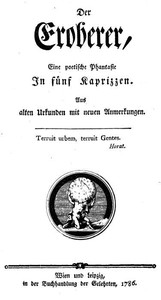
Der Eroberer by Paul Weidmann
Let's set the stage: we're in the 1770s, a time of powdered wigs and philosophical revolutions. Paul Weidmann's Der Eroberer drops us into the court of King Amurat, a ruler who has known nothing but victory. His lands are secure, his commands are law. Yet, he's eaten up by a strange emptiness. He realizes all his conquests are external—cities, battles, titles. They leave him cold. What he craves is a victory over a willing spirit, a triumph of genuine affection that can't be commanded.
The Story
Amurat's solution is to target Ismene, a noblewoman renowned for her intelligence and, crucially, her complete indifference to the king. She represents the ultimate challenge. He uses every tool at his disposal: flattery, pressure, the immense weight of his royal favor. He tries to orchestrate a 'voluntary' surrender of her heart, believing that winning her love will be his crowning achievement. The play becomes this tense, psychological duel. Ismene isn't just a prize; she's a fully realized person with her own will, facing an impossible choice between personal integrity and the overwhelming demand of a sovereign. The central question isn't about battlefields, but about whether true feeling can ever be the result of a campaign.
Why You Should Read It
What grabbed me was how current the conflict feels. Strip away the period setting, and you have a story about toxic masculinity, the loneliness of power, and the fundamental right to say 'no.' Amurat isn't a simple villain; he's tragically stuck in his own worldview, unable to see that love isn't a territory to be annexed. Ismene is a fantastic character—her resistance is her power. Weidmann, writing in the Sturm und Drang era, packs this with big emotions and questions about individual freedom versus societal (or royal) expectation. It's a short, potent play that leaves you thinking long after the last line.
Final Verdict
This is a perfect pick for readers who love classic literature but want to step off the beaten path of Goethe and Schiller. It's ideal for history buffs curious about the ideas bubbling up in the 18th century, and for anyone who enjoys a tight, character-driven drama about the abuse of power and the strength of resistance. Don't let its age fool you—Der Eroberer has a beating, relevant heart.
This masterpiece is free from copyright limitations. Feel free to use it for personal or commercial purposes.
Donald Thomas
4 months agoIf you enjoy this genre, the character development leaves a lasting impact. Exactly what I needed.
Emma Lewis
8 months agoThe fonts used are very comfortable for long reading sessions.
Logan Young
8 months agoA must-have for anyone studying this subject.