
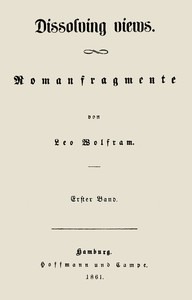
Dissolving Views: Romanfragmente von Leo Wolfram. by Ferdinand Prantner
Read "Dissolving Views: Romanfragmente von Leo Wolfram. by Ferdinand Prantner" Online
This book is available in the public domain. Start reading the digital edition below.
START READING FULL BOOKBook Preview
A short preview of the book’s content is shown below to give you an idea of its style and themes.
Imagine inheriting a trunk full of paper scraps—some typed, some handwritten, all part of a story that was never completed. That’s the starting point for Dissolving Views. The book presents itself as the work of Ferdinand Prantner, who is supposedly editing and commenting on the chaotic literary remains of a man named Leo Wolfram. As Prantner tries to arrange these 'Romanfragmente' (novel fragments) into some kind of order, a shadowy narrative emerges about obsession, art, and a possible crime.
The Story
There isn't a single, clean plot. Instead, we get glimpses: a troubled artist, a lost love, scenes from bohemian life, and hints of a dark secret. The real story is Prantner's own growing fixation. His footnotes start off dry and academic, but slowly become more personal and urgent. He begins to question whether Wolfram's fictional scenes are actually veiled memories. The book becomes a double mystery: what happened to Leo Wolfram, and why is Ferdinand Prantner so desperate to find out?
Why You Should Read It
This isn't a page-turner in the usual sense. It’s a mood. The genius is in the format—the incomplete fragments force you to become the detective, filling in the gaps yourself. You feel Prantner's frustration and fascination as if it were your own. It’s less about solving a crime and more about the haunting power of an unfinished thought. The characters feel real precisely because we only see them in pieces.
Final Verdict
Perfect for readers who loved the layered mysteries of Pale Fire or the atmospheric puzzles in The Shadow of the Wind. If you prefer straightforward stories with clear endings, this might frustrate you. But if you enjoy getting lost in an archival rabbit hole, where the mystery of the author is as compelling as the text, you'll find this strangely beautiful and utterly absorbing.
This book is widely considered to be in the public domain. Use this text in your own projects freely.
Edward Johnson
1 year agoNot bad at all.
Daniel Flores
8 months agoAs someone who reads a lot, the flow of the text seems very fluid. Definitely a 5-star read.


Edward Lewis
1 year agoHonestly, the flow of the text seems very fluid. This story will stay with me.