About 436 minutes
The Works of Edgar Allan Poe — Volume 2 — Edition Insights
Fantasy Juvenile Worlds
100,241 recorded words. 20 minutes difference from this book's estimate.
View Gutenberg source #2148
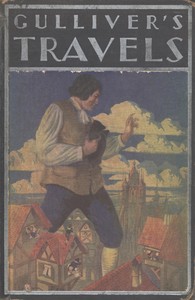
Gulliver's Travels — Key Ideas to Explore can be approached with a clearer sense of reading commitment from its source measurements: 104,858 words, 7 hr 36 min estimated reading time, and 43 detected text sections.
The text analysis averages about 38.1 words per sentence, while the detected sections provide another way to judge how the source is divided.
Project Gutenberg metadata also associates the work with “Fantasy fiction,” connecting these edition facts with the source record’s subject description.
Explore this collection
These alternatives are selected using recorded categories and estimated reading time.
About 436 minutes
Fantasy Juvenile Worlds
100,241 recorded words. 20 minutes difference from this book's estimate.
View Gutenberg source #2148About 413 minutes
Fantasy Juvenile Worlds
94,902 recorded words. 43 minutes difference from this book's estimate.
View Gutenberg source #2147About 402 minutes
Fantasy Juvenile Worlds
92,320 recorded words. 54 minutes difference from this book's estimate.
View Gutenberg source #2150Search stored excerpts and compare books → Choose by your preferences →
Choices use stored catalog measurements. Estimates vary with reading speed. A shared category is a catalog label, not a claim that two books have the same argument or literary quality.
Search reads excerpt text stored with this catalog and links to its associated Gutenberg record. The connection is stored in the site database; this tool does not recheck that every excerpt is word-for-word identical to that external record. Excerpt search does not cover every chapter and does not verify historical publication dates.
Catalog snapshot checked: 2026-09-25. Coverage: 95 public books, 95 available source excerpts.
Read the complete public-domain text at its original source.
Read on Project GutenbergFrom the opening pages, Swift establishes a narrator whose voice is relentlessly factual, even when describing the most fantastical circumstances. Gulliver reports his shipwreck, his discovery of the Lilliputians, and his subsequent confinement with the same measured tone he might use for a trade route. This dispassionate precision becomes the book's central structural device: the more outlandish the situation, the more clinical the description. The reader is never allowed to forget that Gulliver is a practical man, a surgeon by trade, who records dimensions, distances, and political procedures as if compiling a ship's log. This tension between the extraordinary and the ordinary is the engine that drives the satire forward.
Swift's manipulation of scale is not merely a source of wonder but a structural principle that organizes each voyage. In Lilliput, Gulliver is a giant among six-inch people; in Brobdingnag, he is a miniature among giants. The physical proportions dictate the narrative possibilities: in Lilliput, he can stride over cities and extinguish fires with his urine; in Brobdingnag, he is carried in a box and threatened by wasps. The excerpts show Swift attending to the practical consequences of these size differences with obsessive care. Gulliver's pockets are searched, his possessions inventoried, his food rations calculated. The flying island of Laputa introduces a third kind of scale: not size but altitude. The island moves according to magnetic principles, and its inhabitants are so absorbed in abstract thought that they must be tapped on the head to speak. Each voyage thus presents a different axis of proportion—horizontal, vertical, and conceptual—and Swift explores each with the same methodical eye.
Throughout the excerpts, Gulliver is repeatedly bound, searched, carried, or enclosed. In Lilliput, he wakes to find his limbs fastened to the ground; in Brobdingnag, he is placed in a box and later carried by an eagle; in Laputa, he is drawn up by a chain. These moments of physical restraint are mirrored by scenes of being observed: the Lilliputians climb his body, the Brobdingnagian farmer exhibits him for money, the Laputians study him through telescopes. Swift uses these images to create a pattern of vulnerability and display. Gulliver is never fully in control of his own movement; he is always subject to the will of larger or smaller beings. This structural repetition reinforces the satirical point about human powerlessness, even as Gulliver himself remains oblivious to the irony. The reader watches him being watched, and the layers of observation multiply.
The narrative moves through a series of discrete episodes, each introduced by a voyage or a storm. The table of contents reveals a clear pattern: each voyage begins with a departure, a disaster at sea, and an arrival in an unfamiliar land. Within each land, Gulliver moves from confinement to gradual integration, then to crisis and escape. The excerpts show Swift using transitional phrases like "I happened rightly to conjecture" or "by a lucky Accident" to propel the plot forward. These moments of chance are crucial, because they allow Swift to shift scenes without resolving the underlying satire. The journey itself becomes a structural device that prevents any single society from becoming a permanent home. Gulliver is always a traveler, never a settler, and his movement between worlds mirrors the reader's movement between perspectives. The episodic structure also allows Swift to vary the target of his satire—political, scientific, legal—without committing to a single argument.
Gulliver presents himself as a reliable witness, but his observations are consistently filtered through his own assumptions. In the Laputa excerpt, he notes that the island's inhabitants "conferred earnestly with each other, looking often upon me" and that their language "sounded not unlike to the Italian." He assumes that his own gestures and language will be understood, and he interprets their behavior through his own cultural lens. Swift never allows Gulliver to recognize his own limitations; the satire depends on the gap between what Gulliver sees and what the reader understands. This structural irony is reinforced by Gulliver's habit of measuring everything in English units—miles, yards, inches—as if the world can be fully comprehended through quantification. The reader is left to notice what Gulliver misses: the absurdity of his own position, the cruelty of the societies he visits, and the fragility of his own judgments.
Readers approaching this edition should attend to the way Swift builds each voyage from a handful of recurring motifs: binding, measuring, displaying, and escaping. The illustrations by Milo Winter, included in this edition, offer a visual counterpart to Swift's verbal precision. Because the excerpts are incomplete, the full arc of Gulliver's transformation—from confident traveler to misanthropic recluse—can only be glimpsed. But the structural patterns are evident from the opening pages, and they reward careful attention.
Gulliver's scale reversals made me think of childhood afternoons lost in Oz, where size meant so little next to kindness. Woot's quiet wanderings felt like my own aimless reading then—seeking not escape, but understanding. The Tin Woodman of Oz A Faithful Story of the Astonishing Adventure Undertaken by the Tin Woodman, Assisted by Woot the Wanderer, the Scarecrow of Oz, and Polychrome, the — Reading Notes reminded me that even absurd journeys carry a tender weight.
Save your reaction, strongest insight, and memorable passage.