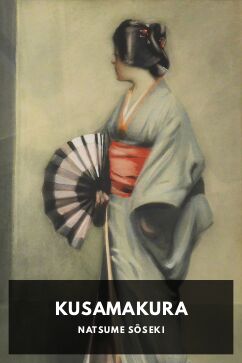
Kusamakura - Natsume Sōseki

(8 User reviews)   1800
By Nicholas Ortiz Posted on Jan 27, 2026
In Category - Law & Society
Natsume Sōseki Natsume Sōseki
English
Okay, I need to tell you about this strange little book that's been living in my head rent-free. It's called *Kusamakura* (or *The Three-Cornered World* in English), and it's by Natsume Sōseki, who's basically the godfather of modern Japanese literature. But forget stuffy classics—this book is a vibe. Imagine a painter, tired of Tokyo, escaping to a remote mountain hot spring village to find some peace and maybe some artistic inspiration. That's our narrator. There's no big plot twist or murder mystery. Instead, the 'conflict' is all internal: can he really detach himself from human emotions and just observe life like a painting? The story becomes a quiet, mesmerizing standoff between his desire for cool, artistic distance and the very real, complicated people he meets, especially the mysterious, beautiful young woman named Nami. The book asks if true art comes from cold observation or from getting your hands dirty with feelings. It's a slow, beautiful, and surprisingly witty meditation that feels like a long, deep breath of mountain air.
Share

Read "Kusamakura - Natsume Sōseki" Online

This book is available in the public domain. Start reading the digital edition below.

START READING FULL BOOK
Instant Access    Mobile Friendly

Book Preview

A short preview of the book’s content is shown below to give you an idea of its style and themes.

Details and other notes may be found at the end of this eBook. MASTERPIECES OF CONTEMPORARY JAPANESE FICTION The Japan Times’ Series ***** UNHUMAN TOUR (KUSAMAKURA) BY SOSEKI NATSUME [Illustration: logo] TRANSLATED BY KAZUTOMO TAKAHASHI THE JAPAN TIMES INTRODUCTION During the eras of Meiji and Taisho (1868–1926) the literary life of Japan was enriched by a wealth of many notable productions, worthy of a place in the atheneum of the world; but strange to say, no attempt has, as yet, been made to embody them into any part of the works forming an international library. It is true, that some Japanese novels have been rendered into English, but such ventures have been few and far between, and in any case, they have been of a fragmentary nature and cannot be considered as a part of any systematic attempt. Literature is the mirror of a living age in which is reflected the life of a people. It is through literature, more than any other medium, that students of the present and future eras may more readily gain an insight into the characteristics and life of a people. The publishers are convinced that the placing before the world, of representative Japanese writings and fictions, will render an inestimable service by bringing to it fuller and better understanding of Japan and the Japanese. “Masterpieces of the Contemporary Japanese Fiction” comprises a few of the most representative works of the age, embodying as it does, the favourite productions of those authors, and which have been rendered into English as faithfully as it has been within the power of the translators to do so. In this present undertaking, the publishers are not actuated by any other motive but to allow the world to understand, and to see Japan, as she really is. THE PUBLISHERS. Tokyo, June, 1927. PREFACE KINNOSUKE NATSUME, better known by his pen-name “Soseki,” was one of, if not, greatest fiction writers, modern Japan has produced. A man of solid university education unlike many another of the fraternity, he established a school of his own, in point of originality in style, and what is more important, in the angle from which he observed human affairs. More points of difference about him from others were the complete absence in his case of romantic elements and adversities, almost always inseparable from the early life of literary geniuses, and the sudden blazing into fame from obscurity, except as a popular school teacher and then a university professor, with some partiality for the “hokku” school of poetry. Soseki Natsume was born in January, 1867, a third son of an old family in Kikui-cho, Tokyo. His education after a primary school course took a deviation, for some years, into the old-fashioned study of Chinese classics. It was probably then that he laid foundation, perhaps unknown to himself, of the development of his literary talent, that later blossomed out so picturesquely; and he was different, also, in this respect from the later Meiji era writers, who went, many of them, through a Christian mission school, and were all under the influence of Western literature. In 1884, our future novelist entered the Yobimon College, intending to become an architect; but later changing his mind he took a course in the Literature Department of Tokyo Imperial University, from which he graduated in 1892. While in the university, Soseki formed a close friendship with Shiki Masaoka, which lasted until the latter’s death separated them in 1904. Shiki Masaoka was the greatest figure in the revival of hokku poetry in ♦rejuvenated Japan, and Soseki’s association with him accounts for the novelist’s mastery of...

This is a limited preview. Download the book to read the full content.

If you're looking for a book with a fast-paced plot, this isn't it. But if you want to be completely transported, to feel like you've taken a long, thoughtful walk through the Japanese countryside, then you're in the right place.

The Story

The story is simple on the surface. An unnamed artist leaves the city for the mountains of Kyushu, hoping to find scenes to paint and, more importantly, a state of mind free from emotional clutter. He wants to see the world as an aesthetic object, not get involved in its dramas. He takes a room at a remote hot spring inn and begins his retreat. His peace is gently interrupted by the people there, especially the innkeeper's daughter, Nami. She's elegant, sharp-tongued, and carries an air of sadness from a broken marriage. As the artist observes her and the villagers—a former soldier turned monk, a local barber—their small stories and conversations begin to chip away at his detached philosophy. The 'action' is in these conversations and the artist's own shifting thoughts as he wrestles with whether his ideal of emotionless art is even possible or desirable.

Why You Should Read It

I loved this book for its quiet intelligence and its humor. Sōseki pokes fun at his own narrator's high-minded ideals. There's a wonderful scene where the artist tries to compose a haiku about the sublime beauty of nature, only to be constantly bothered by a persistent flea! It's this mix of the profound and the silly that makes it feel real. The heart of the book is the tension between the artist and Nami. Their relationship isn't romantic in a typical way; it's more a dance of ideas and subtle challenges. She represents the messy, emotional world he's trying to escape, and she's far too interesting to simply be a subject in a painting. Reading it, you start to question the artist's goal right alongside him. Is detachment a form of wisdom, or is it just a fancy kind of cowardice?

Final Verdict

Kusamakura is perfect for anyone who needs a literary palate cleanser. It's for readers who enjoy beautiful prose, philosophical questions wrapped in a simple story, and characters that feel deeply human. If you like books that meander and make you think, like The Sailor Who Fell from Grace with the Sea or the films of Yasujirō Ozu, you'll find a friend here. It's a short book, but it's dense with feeling and ideas. Don't rush it. Let it soak in, like a long bath in those mountain hot springs.


📚 Legal Disclaimer

No rights are reserved for this publication. Use this text in your own projects freely.

Edward Garcia
1 month ago

I came across this while browsing and the atmosphere created is totally immersive. Don't hesitate to start reading.

Linda Anderson
4 months ago

Simply put, the emotional weight of the story is balanced perfectly. Exactly what I needed.

Elizabeth King
1 year ago

From the very first page, the clarity of the writing makes this accessible. Thanks for sharing this review.

Kevin Lopez
4 months ago

Clear and concise.

Jessica Thompson
1 year ago

This is one of those stories where the character development leaves a lasting impact. Truly inspiring.

4.5
4.5 out of 5 (8 User reviews )

Add a Review

Your Rating *
There are no comments for this eBook.
You must log in to post a comment.
Log in


Related eBooks