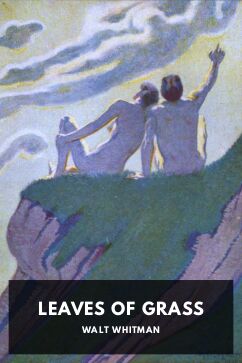
Leaves of Grass - Walt Whitman

(11 User reviews)   2116
By Nicholas Ortiz Posted on Jan 27, 2026
In Category - Legal Drama
Walt Whitman Walt Whitman
English
So I finally read 'Leaves of Grass' after years of seeing it on lists, and wow, I almost wish I'd waited longer. Not because it's bad—it's incredible—but because I don't think I was ready for it. This isn't a story in the normal sense. There's no plot, no villain, no mystery to solve. The conflict is entirely with yourself. It's Whitman standing on a metaphorical street corner, grabbing you by the shoulders, and yelling, 'You! Yes, you! You are a miracle! This grass, this dirt, this body, this messy, beautiful life—it's all sacred.' He argues with every small, doubting voice in your head. The 'mystery' is what happens when you actually start to believe him. It's a book that doesn't want to be analyzed; it wants to be felt. It's chaotic, repetitive, sometimes baffling, and utterly life-affirming. Pick it up when you need to remember what it feels like to be wildly, unapologetically alive.
Share

Read "Leaves of Grass - Walt Whitman" Online

This book is available in the public domain. Start reading the digital edition below.

START READING FULL BOOK
Instant Access    Mobile Friendly

Book Preview

A short preview of the book’s content is shown below to give you an idea of its style and themes.

Therefore I send you my poems that you behold in them what you wanted. To a Historian You who celebrate bygones, Who have explored the outward, the surfaces of the races, the life that has exhibited itself, Who have treated of man as the creature of politics, aggregates, rulers and priests, I, habitan of the Alleghanies, treating of him as he is in himself in his own rights, Pressing the pulse of the life that has seldom exhibited itself, (the great pride of man in himself,) Chanter of Personality, outlining what is yet to be, I project the history of the future. To Thee Old Cause To thee old cause! Thou peerless, passionate, good cause, Thou stern, remorseless, sweet idea, Deathless throughout the ages, races, lands, After a strange sad war, great war for thee, (I think all war through time was really fought, and ever will be really fought, for thee,) These chants for thee, the eternal march of thee. (A war O soldiers not for itself alone, Far, far more stood silently waiting behind, now to advance in this book.) Thou orb of many orbs! Thou seething principle! thou well-kept, latent germ! thou centre! Around the idea of thee the war revolving, With all its angry and vehement play of causes, (With vast results to come for thrice a thousand years,) These recitatives for thee,--my book and the war are one, Merged in its spirit I and mine, as the contest hinged on thee, As a wheel on its axis turns, this book unwitting to itself, Around the idea of thee. Eidolons I met a seer, Passing the hues and objects of the world, The fields of art and learning, pleasure, sense, To glean eidolons. Put in thy chants said he, No more the puzzling hour nor day, nor segments, parts, put in, Put first before the rest as light for all and entrance-song of all, That of eidolons. Ever the dim beginning, Ever the growth, the rounding of the circle, Ever the summit and the merge at last, (to surely start again,) Eidolons! eidolons! Ever the mutable, Ever materials, changing, crumbling, re-cohering, Ever the ateliers, the factories divine, Issuing eidolons. Lo, I or you, Or woman, man, or state, known or unknown, We seeming solid wealth, strength, beauty build, But really build eidolons. The ostent evanescent, The substance of an artist’s mood or savan’s studies long, Or warrior’s, martyr’s, hero’s toils, To fashion his eidolon. Of every human life, (The units gather’d, posted, not a thought, emotion, deed, left out,) The whole or large or small summ’d, added up, In its eidolon. The old, old urge, Based on the ancient pinnacles, lo, newer, higher pinnacles, From science and the modern still impell’d, The old, old urge, eidolons. The present now and here, America’s busy, teeming, intricate whirl, Of aggregate and segregate for only thence releasing, To-day’s eidolons. These with the past, Of vanish’d lands, of all the reigns of kings across the sea, Old conquerors, old campaigns, old sailors’ voyages, Joining eidolons. Densities, growth, facades, Strata of mountains, soils, rocks, giant trees, Far-born, far-dying, living long, to leave, Eidolons everlasting. Exalte, rapt, ecstatic, The visible but their womb of birth, Of orbic tendencies to shape and shape and shape, The mighty earth-eidolon. All space, all time, (The stars, the terrible perturbations of the suns, Swelling, collapsing, ending, serving their longer, shorter use,) Fill’d with eidolons only. The noiseless myriads, The infinite oceans where the rivers empty, The separate countless free identities, like eyesight, The true realities, eidolons. Not this the world, Nor these the universes, they the...

This is a limited preview. Download the book to read the full content.

Let's get this out of the way first: if you're looking for a traditional novel with a clear beginning, middle, and end, you won't find it here. 'Leaves of Grass' is an experience, not a narrative. It's a sprawling, ever-evolving collection of poems that Walt Whitman spent his entire life revising and expanding. There's no single plot. Instead, imagine taking a very long, very observant walk with the most enthusiastic person you've ever met.

The Story

There isn't one, and that's the point. The 'story' is the journey of a single consciousness—Whitman's 'I'—as it travels through America. He sings of everything: the body and the soul, the city crowds and the solitary farmer, the joy of companionship and the peace of being alone. He catalogs the world with relentless, loving detail, from the 'blab of the pave' in Manhattan to the 'leafy lips' of the grass itself. The book is his attempt to contain the entire noisy, democratic, messy spectacle of life within its pages. He doesn't tell a tale; he builds a world, brick by brick, with words.

Why You Should Read It

You should read it because it might change the way you see your own life. Whitman's central idea is radical simplicity: you, exactly as you are, are enough. In a world that constantly tells us to be more, buy more, and achieve more, this 150-year-old book is a shocking breath of fresh air. His celebration of the physical body, of labor, of dirt and sweat and desire, feels incredibly modern. He finds poetry in train conductors and prostitutes, making heroes out of ordinary people. Reading him is like getting a pep talk from the universe. It's not always easy—he can be overwhelming—but when his words hit, they hit hard.

Final Verdict

This book is for the curious, the weary, and anyone who has ever felt small. It's perfect for poetry newcomers scared of 'difficult' verse, because Whitman speaks directly to you in plain, powerful language. It's for people who love America's potential, even when they're frustrated by its reality. Don't try to read it all in one sitting. Dip in and out. Let a few lines marinate. Keep it on your nightstand for when you need a jolt of cosmic optimism. 'Leaves of Grass' isn't just a book you read; it's a companion for life.


⚖️ Public Domain Content

This work has been identified as being free of known copyright restrictions. It is available for public use and education.

Joseph Nguyen
5 months ago

If you enjoy this genre, the plot twists are genuinely surprising. Don't hesitate to start reading.

David Allen
11 months ago

Loved it.

Emma Brown
1 year ago

Surprisingly enough, it manages to explain difficult concepts in plain English. This story will stay with me.

Daniel Perez
1 year ago

I have to admit, the plot twists are genuinely surprising. Exactly what I needed.

Sarah Lee
4 weeks ago

I had low expectations initially, however the atmosphere created is totally immersive. Thanks for sharing this review.

5
5 out of 5 (11 User reviews )

Add a Review

Your Rating *
There are no comments for this eBook.
You must log in to post a comment.
Log in


Related eBooks