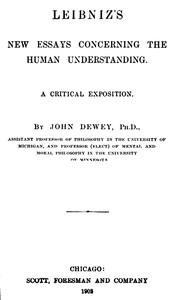
Leibniz's New Essays Concerning the Human Understanding: A Critical Exposition

(8 User reviews)   3791
By Nicholas Ortiz Posted on Dec 25, 2025
In Category - Legal Drama
Dewey, John, 1859-1952 Dewey, John, 1859-1952
English
Ever feel like philosophy is just old guys arguing? John Dewey takes you ringside for one of history's greatest intellectual showdowns. In this book, he acts as our guide to a heavyweight match between two titans: the rationalist Gottfried Leibniz and the empiricist John Locke. The central question is huge—how do we actually know anything? Is knowledge built from our senses and experiences, or is it something innate, already wired into our minds? Dewey doesn't just report the fight; he explains the moves, shows us why they matter, and makes you think about where you stand. It's a surprisingly lively trip into the foundations of modern thought.
Share

Read "Leibniz's New Essays Concerning the Human Understanding: A Critical Exposition" Online

This book is available in the public domain. Start reading the digital edition below.

START READING FULL BOOK
Instant Access    Mobile Friendly

Book Preview

A short preview of the book’s content is shown below to give you an idea of its style and themes.

as possible, including inconsistencies in spelling and hyphenation. Some corrections of spelling and punctuation have been made. They are listed at the end of the text. Italic text has been marked with _underscores_. ] GERMAN PHILOSOPHICAL CLASSICS FOR ENGLISH READERS AND STUDENTS. EDITED BY GEORGE S. MORRIS. LEIBNIZ'S NEW ESSAYS CONCERNING THE HUMAN UNDERSTANDING. LEIBNIZ'S NEW ESSAYS CONCERNING THE HUMAN UNDERSTANDING. A CRITICAL EXPOSITION. By JOHN DEWEY, Ph.D., ASSISTANT PROFESSOR OF PHILOSOPHY IN THE UNIVERSITY OF MICHIGAN, AND PROFESSOR (ELECT) OF MENTAL AND MORAL PHILOSOPHY IN THE UNIVERSITY OF MINNESOTA CHICAGO: SCOTT, FORESMAN AND COMPANY 1902 Copyright, 1888, By S. C. Griggs and Company. PREFACE. The purpose of the series of which the present volume is one, is not, as will be seen by reference to the statement in the initial volume, to sum up _in toto_ the system of any philosopher, but to give a "critical exposition" of some one masterpiece. In treating the "Nouveaux Essais" of Leibniz, I have found myself obliged, at times, to violate the letter of this expressed intention, in order to fulfil its spirit. The "Nouveaux Essais," in spite of its being one of the two most extended philosophical writings of Leibniz, is a compendium of comments, rather than a connected argument or exposition. It has all the suggestiveness and richness of a note-book, but with much also of its fragmentariness. I have therefore been obliged to supplement my account of it by constant references to the other writings of Leibniz, and occasionally to take considerable liberty with the order of the treatment of topics. Upon the whole, this book will be found, I hope, to be a faithful reflex not only of Leibniz's thought, but also of his discussions in the "Nouveaux Essais." In the main, the course of philosophic thought since the time of Leibniz has been such as to render almost self-evident his limitations, and to suggest needed corrections and amplifications. Indeed, it is much easier for those whose thoughts follow the turn that Kant has given modern thinking to appreciate the defects of Leibniz than to realize his greatness. I have endeavored, therefore, in the body of the work, to identify my thought with that of Leibniz as much as possible, to assume his standpoint and method, and, for the most part, to confine express criticism upon his limitations to the final chapter. In particular, I have attempted to bring out the relations of philosophy to the growing science of his times, to state the doctrine of pre-established harmony as he himself meant it, and to give something like consistency and coherency to his doctrine of material existence and of nature. This last task seemed especially to require doing. I have also endeavored to keep in mind, throughout, Leibniz's relations to Locke, and to show the "Nouveaux Essais" as typical of the distinction between characteristic British and German thought. JOHN DEWEY. _May_, 1888. CONTENTS. CHAPTER I. The Man. PAGE His Parents 1 His Early Education 2 His University Training at Leipsic 4 At Jena 8 At the University of Altdorf 10 His Removal to Frankfurt 10 His Mission to Paris 11 Discovery of the Calculus 12 Librarian at Hanover 13 His Activities 14 His Philosophic Writings 15 His Ecclesiastic and Academic Projects 17 His Later Years and Death 18 CHAPTER II. Sources of his Philosophy. Character of the Epoch into which Leibniz was born 20 The Thought of the Unity of the World 23 The two Agencies which formed Leibniz's Philosophy 24 The Cartesian Influences 26 Rationalistic Method 28 Mechanical Explanation of Nature 30 Application of Mathematics 32 Idea of...

This is a limited preview. Download the book to read the full content.

This isn't a story with characters in the usual sense. Instead, the 'plot' is a battle of ideas. John Dewey, a giant of American philosophy himself, steps in to break down Gottfried Leibniz's detailed response to John Locke's famous work, An Essay Concerning Human Understanding. Locke argued that our minds start as a 'blank slate' and that all knowledge comes from experience. Leibniz pushed back, claiming we have built-in mental structures that shape how we understand the world. Dewey walks us through this clash, explaining Leibniz's complex arguments in clearer terms and showing where he agreed or disagreed with Locke.

Why You Should Read It

I picked this up thinking it might be dry, but Dewey is a fantastic teacher. He makes you feel like you're sitting in on a deep, respectful conversation between brilliant minds. You get the sense he's not just explaining history; he's working through the problem himself. The big theme—nature vs. nurture for your brain—is still incredibly relevant today. It makes you question your own assumptions about how you learn and form beliefs. It's less about memorizing who said what and more about watching a fundamental puzzle get taken apart and examined.

Final Verdict

Perfect for curious readers who enjoy history of science podcasts or smart non-fiction but are intimidated by primary source philosophy texts. Dewey does the heavy lifting. You'll come away with a clearer understanding of a major debate that shaped psychology, science, and philosophy. If you've ever wondered about the roots of the 'rationalist vs. empiricist' divide, this is your accessible, insightful starting point.


📜 No Rights Reserved

This content is free to share and distribute. It is now common property for all to enjoy.

Sandra King
3 months ago

Honestly, the clarity of the writing makes this accessible. Highly recommended.

Richard Williams
1 year ago

Perfect.

Kenneth King
9 months ago

Amazing book.

Jackson King
1 year ago

This is one of those stories where the pacing is just right, keeping you engaged. I would gladly recommend this title.

Liam Hill
1 year ago

I started reading out of curiosity and it challenges the reader's perspective in an intellectual way. A true masterpiece.


4.5
4.5 out of 5 (8 User reviews )

Add a Review

Your Rating *
There are no comments for this eBook.
You must log in to post a comment.
Log in


Related eBooks