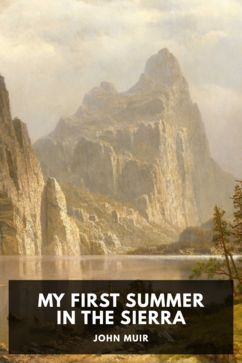
My First Summer in the Sierra - John Muir

(24 User reviews)   3151
By Nicholas Ortiz Posted on Jan 27, 2026
In Category - Legal Drama
John Muir John Muir
English
Okay, imagine this: it's 1869, and you're a scruffy, wide-eyed Scottish immigrant who gets a summer job herding sheep through a place called the Sierra Nevada mountains in California. You've never seen anything like it. That's John Muir. This book is his diary from that summer, and it's not really about sheep at all. It's about falling head-over-heels in love with a landscape so wild and grand it changes you forever. The 'conflict' here is quiet but huge: it's a man's growing awe battling against the creeping sense that this untouched paradise won't stay untouched for long. He watches glaciers carve stone, gets face-to-face with bears, and sleeps under a sky so packed with stars it feels like a dream. Reading it feels like discovering a secret door to a world that's both incredibly ancient and vibrantly alive. If you've ever felt the pull of a mountain trail or wondered what the wilderness sounded like before highways, this is your invitation to time travel.
Share

Read "My First Summer in the Sierra - John Muir" Online

This book is available in the public domain. Start reading the digital edition below.

START READING FULL BOOK
Instant Access    Mobile Friendly

Book Preview

A short preview of the book’s content is shown below to give you an idea of its style and themes.

the Peak, on a day when the “cloud mountains” so inspiring to Mr. Muir were much in evidence. _From a photograph by Herbert W. Gleason_ THE VERNAL FALLS, YOSEMITE NATIONAL PARK 182 _From a photograph by Charles S. Olcott_ THE HAPPY ISLES, YOSEMITE NATIONAL PARK 190 This is the main stream of the Merced River after passing over the Nevada and Vernal Falls and receiving the Illilouette tributary. _From a photograph by Charles S. Olcott_ THE THREE BROTHERS, YOSEMITE NATIONAL PARK 208 The highest rock, called Eagle Point, is 7900 feet above the sea, and 3900 feet above the floor of the valley. _From a photograph by Charles S. Olcott_ MAP OF THE YOSEMITE NATIONAL PARK 264 _From the United States Geological Survey_ FROM SKETCHES MADE BY THE AUTHOR IN 1869 HORSESHOE BEND, MERCED RIVER 14 ON SECOND BENCH. EDGE OF THE MAIN FOREST BELT, ABOVE COULTERVILLE, NEAR GREELEY’S MILL 14 CAMP, NORTH FORK OF THE MERCED 38 MOUNTAIN LIVE OAK (_Quercus chrysolepis_), EIGHT FEET IN DIAMETER 38 SUGAR PINE 50 DOUGLAS SQUIRREL OBSERVING BROTHER MAN 68 DIVIDE BETWEEN THE TUOLUMNE AND THE MERCED, BELOW HAZEL GREEN 86 TRACK OF SINGING DANCING GRASSHOPPER IN THE AIR OVER NORTH DOME 140 ABIES MAGNIFICA (MOUNT CLARK, TOP OF SOUTH DOME, MOUNT STARR KING) 142 ILLUSTRATING GROWTH OF NEW PINE FROM BRANCH BELOW THE BREAK OF AXIS OF SNOW-CRUSHED TREE 144 APPROACH OF DOME CREEK TO YOSEMITE 150 JUNIPERS IN TENAYA CA—ON 164 VIEW OF TENAYA LAKE SHOWING CATHEDRAL PEAK 196 ONE OF THE TRIBUTARY FOUNTAINS OF THE TUOLUMNE CA—ON WATERS, ON THE NORTH SIDE OF THE HOFFMAN RANGE 196 GLACIER MEADOW, ON THE HEADWATERS OF THE TUOLUMNE, 9500 FEET ABOVE THE SEA 204 MONO LAKE AND VOLCANIC CONES, LOOKING SOUTH 228 HIGHEST MONO VOLCANIC CONES (NEAR VIEW) 228 ONE OF THE HIGHEST MOUNT RITTER FOUNTAINS 240 GLACIER MEADOW STREWN WITH MORAINE BOULDERS, 10,000 FEET ABOVE THE SEA (NEAR MOUNT DANA) 248 FRONT OF CATHEDRAL PEAK 248 VIEW OF UPPER TUOLUMNE VALLEY 252 MY FIRST SUMMER IN THE SIERRA CHAPTER I THROUGH THE FOOTHILLS WITH A FLOCK OF SHEEP In the great Central Valley of California there are only two seasons—spring and summer. The spring begins with the first rainstorm, which usually falls in November. In a few months the wonderful flowery vegetation is in full bloom, and by the end of May it is dead and dry and crisp, as if every plant had been roasted in an oven. Then the lolling, panting flocks and herds are driven to the high, cool, green pastures of the Sierra. I was longing for the mountains about this time, but money was scarce and I couldn’t see how a bread supply was to be kept up. While I was anxiously brooding on the bread problem, so troublesome to wanderers, and trying to believe that I might learn to live like the wild animals, gleaning nourishment here and there from seeds, berries, etc., sauntering and climbing in joyful independence of money or baggage, Mr. Delaney, a sheep-owner, for whom I had worked a few weeks, called on me, and offered to engage me to go with his shepherd and flock to the headwaters of the Merced and Tuolumne rivers—the very region I had most in mind. I was in the mood to accept work of any kind that would take me into the mountains whose treasures I had tasted last summer in the Yosemite region. The flock, he explained, would be moved gradually higher through the successive forest belts as the snow melted, stopping for a few weeks at the best places we came to. These...

This is a limited preview. Download the book to read the full content.

In the summer of 1869, a young John Muir took a job as a shepherd, guiding a flock of sheep and their owner into the high country of California's Sierra Nevada. But this is no ordinary travelogue. The sheep are barely side characters in Muir's real story: his total, joyful immersion into a wilderness he had only dreamed of.

The Story

The book is built from his journal entries. We follow him day by day as he hikes ahead of the flock, utterly captivated. He describes everything with the excitement of a kid in a candy store, if the candy was thousand-year-old sequoia trees, glittering lakes, and meadows bursting with wildflowers. He scales cliffs just to see the view, gives playful names to the plants and animals he meets, and spends stormy nights perched in the treetops to feel the wind rock him. The plot is the landscape itself—its changing moods, its hidden corners, and the slow, deep way it stamps itself on his soul.

Why You Should Read It

You should read this because Muir makes you see the natural world not as a postcard, but as a living, breathing companion. His writing isn't stiff or scientific; it's full of wonder. He talks about a water ouzel bird doing a "joyous dance" in a waterfall spray and describes sunlight on a mountain peak like it's a religious experience. What hit me hardest was the quiet urgency underneath the beauty. Even then, he saw the marks of grazing sheep and the potential for loss. This book is the seed that grew into his life's work as a conservationist. It captures the exact moment he went from being a visitor in the mountains to becoming their most passionate voice.

Final Verdict

This book is perfect for anyone who needs a dose of quiet awe. It's for the weekend hiker, the aspiring naturalist, or anyone who feels drained by the noise of modern life. It's not an action-packed adventure; it's a slow, rich soak in a pristine world. Think of it as the ultimate nature detox, written by the man who would help create our national parks. Keep it on your nightstand. A few pages will calm your mind and remind you what's really worth protecting.


🔖 Community Domain

There are no legal restrictions on this material. You can copy, modify, and distribute it freely.

Ethan Davis
1 year ago

Five stars!

Oliver Thompson
1 year ago

High quality edition, very readable.

Michael Nguyen
2 years ago

Finally found time to read this!

Kimberly Taylor
1 year ago

I have to admit, the character development leaves a lasting impact. Exceeded all my expectations.

5
5 out of 5 (24 User reviews )

Add a Review

Your Rating *
There are no comments for this eBook.
You must log in to post a comment.
Log in


Related eBooks