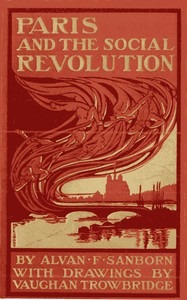
Paris and the Social Revolution by Alvan F. Sanborn

(24 User reviews)   5308
By Nicholas Ortiz Posted on Dec 25, 2025
In Category - Law & Society
Sanborn, Alvan F. (Alvan Francis), 1866-1966 Sanborn, Alvan F. (Alvan Francis), 1866-1966
English
Ever wondered what it was like to live in Paris when the world was tipping upside down? 'Paris and the Social Revolution' isn't about kings and generals—it's about the people. Alvan F. Sanborn, an American journalist who was actually there, takes you into the cafes, the crowded streets, and the heated meetings of late 19th-century Paris. He shows you the simmering anger of workers, the big ideas of socialists and anarchists, and the moments when protest boiled over into violence. It reads like a series of vivid, eyewitness reports from a city wrestling with its future. If you think history is about dates and treaties, this book will change your mind. It's history with mud on its boots and a fire in its eyes.
Share

Read "Paris and the Social Revolution by Alvan F. Sanborn" Online

This book is available in the public domain. Start reading the digital edition below.

START READING FULL BOOK
Instant Access    Mobile Friendly

Book Preview

A short preview of the book’s content is shown below to give you an idea of its style and themes.

the pre-Revolutionary Encyclopedists (especially Diderot and Rousseau). I even pass by the far more pertinent teachings, systems, personalities, and careers of the admitted precursors of modern anarchism; of Max Stirner and Fourier, of Proudhon, the father of modern anarchist doctrine, and of “the mysterious Russian,” Bakounine, the father of the modern anarchist party. I also pass by the agrarian revolt of Gracchus Babœuf (guillotined by Barras in 1797); the emergence of the learned Russian Kropotkine, and of the Italians Cafiero and Malatesta; the relations between French anarchism and Russian nihilism; the struggle for Italian liberation; the founding of the _Internationale_ and of the _Fédération Jurasienne_; the epic struggle for the control of the _Internationale_ between Karl Marx, representing authoritative centralisation, and Bakounine, representing anti-authoritative federalism. I neglect, in a word, the more than interesting history of the slow evolution of modern anarchism, and coming directly, without further ado, to the France of to-day, attack the questions,—What is anarchy? What does the anarchist want? And how does he hope to get it? Of the contemporary French Encyclopedists who are preparing, or think they are preparing, the revolution of the twentieth century, three are eminently fitted by their learning, by their capacity for straight thinking and utterance, by their sense of historical perspective, their power of keen analysis and bold synthesis, by their breadth, their tolerance, their humanity, their integrity, and their consecration, to answer these questions. They are Pierre Kropotkine, Elisée Reclus, and Jean Grave. But Kropotkine, while the author of such epoch-making works as _La Conquête du Pain, L’Anarchie: son Idéal_, and _Les Paroles d’un Révolté_, is a Russian, not a Frenchman, by birth and breeding, and has been little in Paris of late; and Reclus[1] (one of the most learned geographers of his time), though never far away from the anarchist movement, is, by reason of his devotion to his specialty, rarely in the thick of it. Besides, he has made his home in Belgium for many years. It is to Jean Grave, therefore, the youngest of the three, the present editor of the journal _Les Temps Nouveaux_ and author of _La Société Mourante_, _La Société Future_, _La Société au Lendemain de la Révolution_, _L’Individu et la Société_, and _L’Anarchie: son But, ses Moyens_, that it seems best to confide the delicate task of presenting the French anarchistic idea and ideal; and, because I cannot trust myself to summarise without bias the _credo_ of a sect to which I do not belong, I quote in full the comprehensive first chapter of his important doctrinal volume, _L’Anarchie: son But, ses Moyens_:— “In spite of the fact that the idea of anarchy has emerged from the obscurity in which men have attempted to stifle it, in spite of the fact that to-day (thanks to persecution, thanks to laws of exception such as are made in the worst monarchies) the words ‘anarchy’ and ‘anarchist’ are unfamiliar to none, there are not many who know exactly what anarchy is. “The intervention of the anarchists in the Dreyfus affair, where they were much in evidence, had the effect of bringing them into contact with bourgeois politicians, who knew absolutely nothing about them; but anarchy did not come out into a clearer light from this association. “Anarchy, in the eyes of some, is robbery, assassination, bombs, a return to savagery; anarchists are only house-breakers, loafers, who would divide all wealth in order to be able to amuse themselves with doing nothing. “In the eyes of others, anarchy is a sort of Utopia, of golden-age dream which they readily grant to be very beautiful, but a...

This is a limited preview. Download the book to read the full content.

Alvan F. Sanborn lived in Paris during one of its most turbulent periods, and he wrote down what he saw. This book is his collection of observations and stories from the front lines of social change. He doesn't give you a dry political timeline. Instead, he introduces you to the characters driving the revolution: fiery speakers in basement clubs, desperate strikers on the picket line, and ordinary Parisians debating the future on every street corner.

The Story

There isn't a single plot, but a mosaic of moments. Sanborn acts as your guide through the explosive growth of worker unions, the rise of radical political groups, and the violent clashes with police. He covers famous events like the protests surrounding the execution of anarchist Auguste Vaillant, but he's just as focused on the quiet, daily struggles that fueled the unrest. The "story" is the slow, painful, and often chaotic birth of modern social justice movements in the heart of Europe's most glamorous city.

Why You Should Read It

This book has an energy that many histories lack. Because Sanborn was a reporter, his writing is immediate. You feel the tension in the air and the passion in the speeches. It completely shatters the romantic postcard image of Paris. He shows you a city divided by incredible wealth and grinding poverty, which makes all the revolutionary fervor make perfect sense. It's a powerful reminder that big ideas about fairness and equality aren't abstract—they're born in real streets, with real stakes.

Final Verdict

Perfect for readers who love narrative nonfiction that transports them to another time. If you enjoyed books like The Ghost Map or Devil in the White City for their immersive quality, you'll appreciate Sanborn's frontline journalism. It's also a great pick for anyone interested in the roots of today's social movements. Just be ready for a portrait of Paris that's grittier, louder, and far more fascinating than the one you know.


📢 Community Domain

The copyright for this book has expired, making it public property. Feel free to use it for personal or commercial purposes.

Charles King
1 year ago

Wow.

Ashley Ramirez
10 months ago

Beautifully written.

Noah Thomas
1 year ago

Compatible with my e-reader, thanks.

Joseph Harris
1 year ago

Great reference material for my coursework.

Edward Walker
1 year ago

Thanks for the recommendation.

4.5
4.5 out of 5 (24 User reviews )

Add a Review

Your Rating *
There are no comments for this eBook.
You must log in to post a comment.
Log in


Related eBooks