
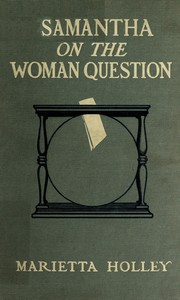
Samantha on the Woman Question by Marietta Holley
Published in 1913, Marietta Holley's book introduces us to Samantha Allen, a sensible farm wife from upstate New York. The story isn't a traditional plot with twists and turns. Instead, it's built around conversations and Samantha's observations. When the hot topic of women's rights—the 'Woman Question'—reaches her rural community, Samantha decides to give her two cents. We follow her as she debates her traditionalist husband, Josiah, talks with her neighbors, and reflects on everything from a woman's right to vote and own property to the absurdity of restrictive fashions.
The Story
The book is a series of witty dialogues and monologues. Samantha uses her everyday experiences—running a household, dealing with community gossip, managing finances—to challenge the arguments against women's equality. She points out the contradictions in a society that praises a woman's managerial skills at home but doubts her ability to manage a vote. Her logic is straightforward and often funny, cutting through complex political debates with farmyard analogies and plain talk. The central 'conflict' is her good-natured but firm battle of wits against the outdated ideas held by Josiah and the world he represents.
Why You Should Read It
You should read this because Samantha is a delight. She's not a fiery radical on a soapbox; she's your clever, overworked aunt explaining why the world is silly. Holley's genius is in using humor as a weapon. Samantha's jokes make the unfairness of the laws and attitudes toward women glaringly obvious. It’s incredibly refreshing to see these serious issues discussed without academic jargon, but with the sharp, relatable wit of someone living the consequences. The book feels surprisingly modern in its frustrations, even though it's over a century old. It’s a powerful reminder that the fight for rights has always been argued in kitchens and parlors, not just courtrooms.
Final Verdict
This book is perfect for anyone who loves character-driven humor with a side of social history. If you enjoy Mark Twain's satire or the down-to-earth charm of Laura Ingalls Wilder's stories, you'll find a kindred spirit in Samantha. It's a fantastic pick for book clubs—there's so much to discuss about how far we've come and what arguments sadly still sound familiar. Don't go in expecting a fast-paced novel. Go in ready to sit at Samantha's table, enjoy a slice of her pie, and listen to her brilliantly dismantle sexism one folksy story at a time. It’s a funny, smart, and quietly revolutionary read.
This masterpiece is free from copyright limitations. It is available for public use and education.
Linda Smith
3 months agoThe research depth is palpable from the very first chapter.
Sarah Miller
1 year agoBefore I started my latest project, I read this and the way the author breaks down the core concepts is remarkably clear. Truly a masterpiece of digital educational material.
Emily Martinez
2 months agoOne of the most comprehensive guides I've read this year.
Ashley Jones
2 months agoI stumbled upon this title during my weekend research and the bibliography and references suggest a high level of research and authority. I'll be recommending this to my students and colleagues alike.


Paul Wilson
8 months agoAs a long-time follower of this subject matter, the breakdown of complex theories into digestible segments is masterfully done. A perfect balance of theory and practical advice.