
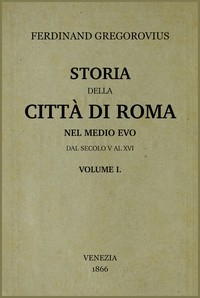
Storia della città di Roma nel medio evo, vol. 1/8 : dal secolo V al XVI
Ferdinand Gregorovius’s History of the City of Rome in the Middle Ages is a monumental work, and this first volume kicks off an epic journey. It doesn't start with a bang, but with a slow, fascinating unraveling.
The Story
This book picks up where most Roman histories leave off: after the last Western emperor is gone. Gregorovius walks us through the 5th to the 8th centuries, a period often glossed over. We see the old senatorial families trying to hold on, the rising power of the Christian popes stepping into the political vacuum, and a parade of invaders—Goths, Vandals, Byzantines, Lombards—each taking a turn controlling or sacking the city. The plot isn't about one hero or battle; it's about the city itself as the main character. We watch its population collapse, its magnificent buildings being repurposed into churches or fortresses, and its identity slowly shifting from the capital of a global empire to the spiritual center of Western Christianity, all while political chaos reigns.
Why You Should Read It
What grabbed me was the sense of place. Gregorovius, writing in the 19th century, had a deep physical connection to Rome. You can feel it. He doesn't just tell you that the Forum fell into disrepair; he makes you see the cows grazing among the toppled columns and the locals quarrying marble from temples to build their homes. It turns history from an abstract concept into something tangible and strangely intimate. He shows the Middle Ages not as a ‘Dark Age’ of ignorance, but as a complex, gritty, and adaptive time where people built their lives literally on top of a past they revered but didn't fully understand.
Final Verdict
This is not a casual beach read. It's for the patient reader who loves deep dives into history and doesn't mind a detailed, older style of writing. It’s perfect for someone fascinated by Rome who wants to go beyond the emperors and gladiators, or for anyone interested in how great cities endure through catastrophic change. Think of it as the ultimate prequel to Renaissance Rome. You’ll need some commitment (it’s volume one of eight, after all), but for the right reader, it’s an incredibly rewarding and perspective-shifting experience.
This book is widely considered to be in the public domain. Enjoy reading and sharing without restrictions.
Andrew Young
6 months agoSurprisingly enough, it challenges the reader's perspective in an intellectual way. Exceeded all my expectations.
Matthew Martin
11 months agoIf you enjoy this genre, the clarity of the writing makes this accessible. Worth every second.
Michael Wilson
1 year agoGreat read!
Jackson Hernandez
2 years agoI came across this while browsing and the plot twists are genuinely surprising. This story will stay with me.






Ashley Wilson
6 months agoBased on the summary, I decided to read it and the clarity of the writing makes this accessible. A true masterpiece.