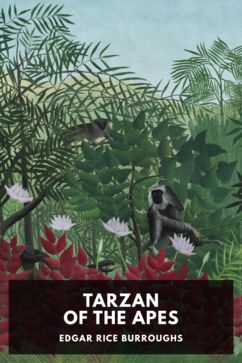
Tarzan of the Apes - Edgar Rice Burroughs

(12 User reviews)   2622
By Nicholas Ortiz Posted on Jan 27, 2026
In Category - Legal Drama
Edgar Rice Burroughs Edgar Rice Burroughs
English
Okay, so you know the basic idea—man raised by apes in the jungle. But this original 1912 story is way wilder and weirder than any movie version. It starts with a British lord and lady marooned on the African coast. They have a baby, build a treehouse, and then... things go very wrong. The baby is left alone. That baby is found and raised by a tribe of great apes, who call him 'Tarzan' (which means 'white skin'). We follow him as he grows up, learning the brutal laws of the jungle, discovering the strange hut his human parents built, and teaching himself to read using leftover children's books. The real kicker? Years later, another group of Europeans arrives, including a sharp, curious American woman named Jane Porter. Tarzan, now a formidable and intelligent man of the jungle, watches them from the trees. The central question isn't just if he'll save them from jungle dangers (he will), but what happens when this man, caught perfectly between two worlds, encounters civilization and love for the first time. It's a surprisingly gripping mix of survival adventure, social commentary, and pure, old-fashioned romance.
Share

Read "Tarzan of the Apes - Edgar Rice Burroughs" Online

This book is available in the public domain. Start reading the digital edition below.

START READING FULL BOOK
Instant Access    Mobile Friendly

Book Preview

A short preview of the book’s content is shown below to give you an idea of its style and themes.

during the days that followed for the balance of the strange tale. When my convivial host discovered that he had told me so much, and that I was prone to doubtfulness, his foolish pride assumed the task the old vintage had commenced, and so he unearthed written evidence in the form of musty manuscript, and dry official records of the British Colonial Office to support many of the salient features of his remarkable narrative. I do not say the story is true, for I did not witness the happenings which it portrays, but the fact that in the telling of it to you I have taken fictitious names for the principal characters quite sufficiently evidences the sincerity of my own belief that it _may_ be true. The yellow, mildewed pages of the diary of a man long dead, and the records of the Colonial Office dovetail perfectly with the narrative of my convivial host, and so I give you the story as I painstakingly pieced it out from these several various agencies. If you do not find it credible you will at least be as one with me in acknowledging that it is unique, remarkable, and interesting. From the records of the Colonial Office and from the dead man’s diary we learn that a certain young English nobleman, whom we shall call John Clayton, Lord Greystoke, was commissioned to make a peculiarly delicate investigation of conditions in a British West Coast African Colony from whose simple native inhabitants another European power was known to be recruiting soldiers for its native army, which it used solely for the forcible collection of rubber and ivory from the savage tribes along the Congo and the Aruwimi. The natives of the British Colony complained that many of their young men were enticed away through the medium of fair and glowing promises, but that few if any ever returned to their families. The Englishmen in Africa went even further, saying that these poor blacks were held in virtual slavery, since after their terms of enlistment expired their ignorance was imposed upon by their white officers, and they were told that they had yet several years to serve. And so the Colonial Office appointed John Clayton to a new post in British West Africa, but his confidential instructions centered on a thorough investigation of the unfair treatment of black British subjects by the officers of a friendly European power. Why he was sent, is, however, of little moment to this story, for he never made an investigation, nor, in fact, did he ever reach his destination. Clayton was the type of Englishman that one likes best to associate with the noblest monuments of historic achievement upon a thousand victorious battlefields—a strong, virile man—mentally, morally, and physically. In stature he was above the average height; his eyes were gray, his features regular and strong; his carriage that of perfect, robust health influenced by his years of army training. Political ambition had caused him to seek transference from the army to the Colonial Office and so we find him, still young, entrusted with a delicate and important commission in the service of the Queen. When he received this appointment he was both elated and appalled. The preferment seemed to him in the nature of a well-merited reward for painstaking and intelligent service, and as a stepping stone to posts of greater importance and responsibility; but, on the other hand, he had been married to the Hon. Alice Rutherford for scarce a three months, and it was the thought of taking this fair young girl into the dangers and...

This is a limited preview. Download the book to read the full content.

Let's set the scene: 1888. A British couple, Lord and Lady Greystoke, are marooned on the remote West African coast after a shipboard mutiny. They have a son, build a crude shelter in the trees, and try to survive. Tragedy strikes, and their infant boy is left utterly alone. He's found by Kala, a grieving female ape who has just lost her own baby. She adopts him, naming him Tarzan ('White Skin').

The Story

The first half of the book is an incredible survival story. We see Tarzan grow up in the ape tribe, facing constant danger from beasts and rival apes. His human intelligence gives him an edge; he invents tools, learns to use a rope, and eventually discovers his parents' cabin. Inside, he finds books and teaches himself to read English, creating a huge divide between his feral life and his intellectual awakening. The second half kicks off when a new expedition, including the lively American Jane Porter and her stuffy suitor, arrives. Tarzan, now a silent guardian, saves Jane from multiple perils. A powerful connection forms between the civilized woman and the jungle lord, forcing Tarzan to confront who—and what—he truly is.

Why You Should Read It

Look past the dated parts (and there are a few). At its heart, this is a story about identity. Tarzan isn't just a brute; he's a thoughtful outsider observing both ape society and human society with a critical eye. His struggle isn't about becoming human, but about deciding which world's values are worth keeping. Jane is also a great character—brave, practical, and far more adaptable than the men around her. Their relationship feels urgent and real. Plus, Burroughs' jungle is a vivid, thrilling, and terrifying place. The action scenes are fantastic.

Final Verdict

This is a must-read for anyone who loves adventure stories with real heart. It's perfect for fans of classic pulp fiction, anyone curious about the source of a pop culture icon, and readers who enjoy stories about nature vs. nurture. If you liked The Jungle Book but want something with more edge and romance, you'll tear through this. Just be ready for a book that's both of its time and somehow timeless.


📢 No Rights Reserved

No rights are reserved for this publication. Thank you for supporting open literature.

Mary Moore
7 months ago

Honestly, it provides a comprehensive overview perfect for everyone. One of the best books I've read this year.

Donald Garcia
1 year ago

Having read this twice, the depth of research presented here is truly commendable. Truly inspiring.

Edward Sanchez
1 year ago

I had low expectations initially, however the plot twists are genuinely surprising. I would gladly recommend this title.

William Taylor
1 year ago

Wow.

Patricia Miller
8 months ago

Clear and concise.

4.5
4.5 out of 5 (12 User reviews )

Add a Review

Your Rating *
There are no comments for this eBook.
You must log in to post a comment.
Log in


Related eBooks