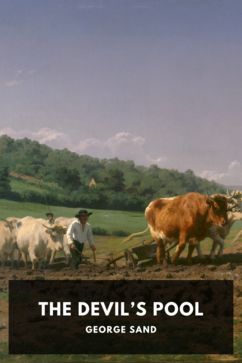
The Devil’s Pool - George Sand

(4 User reviews)   1487
By Nicholas Ortiz Posted on Jan 27, 2026
In Category - Justice Studies
George Sand George Sand
English
Hey, have you ever read a book that feels like a warm afternoon in the countryside? That's 'The Devil's Pool' for you. It's not about demons or anything scary, despite the title. It's about Germain, a young widowed farmer everyone thinks should remarry. He sets off to a neighboring village to meet a potential new wife, taking a shortcut through some spooky woods called the Devil's Pool. The real magic happens on the journey. He's got his little son with him, and they meet a poor but sharp young shepherdess named Marie. What starts as a simple trip becomes this beautiful, quiet story about finding love in the most unexpected place—not where you're told to look, but where your heart feels at home. If you're tired of flashy plots and just want a story that feels genuine and sweet, with characters who seem like real people, you'll love this. It's a hidden gem.
Share

Read "The Devil’s Pool - George Sand" Online

This book is available in the public domain. Start reading the digital edition below.

START READING FULL BOOK
Instant Access    Mobile Friendly

Book Preview

A short preview of the book’s content is shown below to give you an idea of its style and themes.

in this scene of toil and sorrow. It is a fantastic creature. A skeleton armed with a whip, who acts as plowboy to the old laborer, and running along through the furrow beside the terrified horses, goads them on. This is the specter Death, whom Holbein has introduced allegorically into that series of religious and philosophic subjects, at once melancholy and grotesque, entitled “The Dance of Death.” In this collection, or rather this mighty composition, where Death, who plays his part on every page, is the connecting link and predominating thought, Holbein has called up kings, popes, lovers, gamesters, drunkards, nuns, courtesans, thieves, warriors, monks, Jews, and travelers,--all the people of his time and our own; and everywhere the specter Death is among them, taunting, threatening, and triumphing. He is absent from one picture only, where Lazarus, lying on a dunghill at the rich man’s door, declares that the specter has no terrors for him; probably because he has nothing to lose, and his existence is already a life in death. Is there comfort in this stoical thought of the half-pagan Christianity of the Renaissance, and does it satisfy religious souls? The upstart, the rogue, the tyrant, the rake, and all those haughty sinners who make an ill use of life, and whose steps are dogged by Death, will be surely punished; but can the reflection that death is no evil make amends for the long hardships of the blind man, the beggar, the madman, and the poor peasant? No! An inexorable sadness, an appalling fatality brood over the artist’s work. It is like a bitter curse, hurled against the fate of humanity. Holbein’s faithful delineation of the society in which he lived is, indeed, painful satire. His attention was engrossed by crime and calamity; but what shall we, who are artists of a later date, portray? Shall we look to find the reward of the human beings of to-day in the contemplation of death, and shall we invoke it as the penalty of unrighteousness and the compensation of suffering? No, henceforth, our business is not with death, but with life. We believe no longer in the nothingness of the grave, nor in safety bought with the price of a forced renunciation; life must be enjoyed in order to be fruitful. Lazarus must leave his dunghill, so that the poor need no longer exult in the death of the rich. All must be made happy, that the good fortune of a few may not be a crime and a curse. As the laborer sows his wheat, he must know that he is helping forward the work of life, instead of rejoicing that Death walks at his side. We may no longer consider death as the chastisement of prosperity or the consolation of distress, for God has decreed it neither as the punishment nor the compensation of life. Life has been blessed by Him, and it is no longer permissible for us to leave the grave as the only refuge for those whom we are unwilling to make happy. There are some artists of our own day, who, after a serious survey of their surroundings, take pleasure in painting misery, the sordidness of poverty, and the dunghill of Lazarus. This may belong to the domain of art and philosophy; but by depicting poverty as so hideous, so degraded, and sometimes so vicious and criminal, do they gain their end, and is that end as salutary as they would wish? We dare not pronounce judgment. They may answer that they terrify the unjust rich man by pointing out to him the yawning...

This is a limited preview. Download the book to read the full content.

Let's talk about a book that proves a simple journey can be the most interesting story of all. George Sand's The Devil's Pool is a quiet, beautiful novel set in the French countryside.

The Story

Germain is a kind farmer, a young widower left to care for his three children. His family and neighbors are sure he needs a new wife, so they arrange for him to visit a wealthy widow in a distant village. It seems like a sensible plan. He sets off on the trip with his youngest son, Petit-Pierre, clinging to him. To save time, they take a path through a forest haunted by the legend of the Devil's Pool—a place where supernatural mischief is said to occur.

On the way, they meet Marie, a brave and gentle sixteen-year-old girl traveling to a nearby farm to work as a shepherdess. She's poor but possesses a wisdom and goodness that immediately charms little Pierre. When they get lost in the foggy woods near the Devil's Pool, it's Marie's calm strength that guides them to safety. Germain's planned meeting with the widow feels hollow and awkward in comparison to the easy connection he's found with Marie. The rest of the story follows Germain as he figures out where his happiness truly lies.

Why You Should Read It

This book won me over with its heart. Sand writes about rural life with such affection and detail that you can almost smell the damp earth and hear the sheep. Germain and Marie aren't glamorous heroes; they're good, hardworking people, and their growing respect and love feel incredibly real. The central idea is powerful but gentle: true partnership isn't about social plans or wealth, but about finding someone whose soul matches yours. Marie's intelligence and moral strength shine, making her a fantastic character. It's also a wonderful look at the bond between a father and his son, which adds so much warmth to the story.

Final Verdict

Perfect for anyone who loves character-driven stories, classic literature that's easy to read, or tales set in nature. If you enjoy authors like Thomas Hardy or Elizabeth Gaskell, you'll find a friend in George Sand. It's also a great pick if you want a classic that focuses on emotion and everyday life rather than complex plots. This is a comforting, hopeful book that stays with you, like a memory of a perfect, sunny day.


🔖 Usage Rights

This work has been identified as being free of known copyright restrictions. Knowledge should be free and accessible.

Jennifer Moore
1 year ago

Clear and concise.

Kenneth Williams
1 year ago

Amazing book.

Brian Nguyen
11 months ago

Enjoyed every page.

Emily Martin
1 year ago

From the very first page, it manages to explain difficult concepts in plain English. I learned so much from this.


4.5
4.5 out of 5 (4 User reviews )

Add a Review

Your Rating *
There are no comments for this eBook.
You must log in to post a comment.
Log in


Related eBooks