
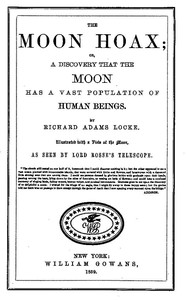
The moon hoax : or, A discovery that the moon has a vast population of human…
Let's set the scene: New York City, August 1835. A new newspaper called The Sun was fighting for readers. Then, they started publishing a series of incredible articles claiming a famous astronomer, Sir John Herschel, had built a massive telescope in South Africa and made mind-blowing discoveries about the moon.
The Story
The articles read like straight science. They describe lush lunar forests, beaches of brilliant white sand, and strange, beautiful animals. Then comes the big reveal: the astronomer spots intelligent life. He observes humanoid figures with bat-like wings, gracefully flying around and building communities. The author, Richard Adams Locke, filled the reports with just enough technical jargon and references to real scientists to make it all sound perfectly plausible. For weeks, New York was captivated. The Sun's circulation shot through the roof as people eagerly awaited each new installment detailing the lunar civilization.
Why You Should Read It
Reading this today is a trip. You get to see the exact words that fooled a city. It's not a dry historical account; it's the primary source. You can feel the excitement and the meticulous detail Locke poured into his lie. What I find most interesting isn't the fake bat-people, but the psychology behind it. Locke was actually satirizing some truly wild scientific and religious theories that were popular then. He thought people would see the joke. Instead, they saw a dream—the dream of not being alone in the universe, of a world of pure wonder just a telescope's gaze away. The book is a brilliant, accidental case study in how the media works, what makes a story go viral, and our timeless hunger for discovery. It reminds me so much of modern internet hoaxes and conspiracy theories.
Final Verdict
This is a must-read for anyone who loves a good story about a story. It's perfect for history buffs who enjoy the weird corners of the past, for media and journalism students, and for sci-fi fans curious about one of the genre's early, reality-bending ancestors. It's short, surprisingly funny in hindsight, and a powerful reminder that getting people to look up at the moon is sometimes easier than getting them to question what they're reading on the page in front of them.
This text is dedicated to the public domain. You are welcome to share this with anyone.
Joshua Ramirez
2 years agoA bit long but worth it.
Joshua Moore
11 months agoI came across this while browsing and the character development leaves a lasting impact. I learned so much from this.
Donna Thompson
1 year agoI have to admit, it provides a comprehensive overview perfect for everyone. Highly recommended.
Mary Lee
1 year agoI had low expectations initially, however the storytelling feels authentic and emotionally grounded. Exceeded all my expectations.


Deborah Martinez
1 year agoPerfect.