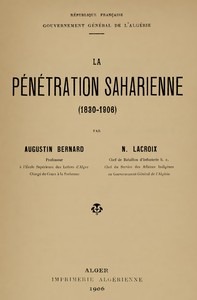
La pénétration saharienne (1830-1906) by Augustin Bernard and Napoléon Lacroix

(16 User reviews)   5453
By Nicholas Ortiz Posted on Dec 25, 2025
In Category - Justice Studies
Lacroix, Napoléon, 1855-1910 Lacroix, Napoléon, 1855-1910
French
Ever wonder how France took over the Sahara? This isn't a dry history book—it’s the real, gritty story of the men who tried to conquer one of the world's harshest deserts. Forget romantic Lawrence of Arabia stuff; this is about colonial ambition crashing into sandstorms, tribal resistance, and sheer human endurance. Bernard and Lacroix pull from military reports and explorer diaries to show you the Sahara not as an empty map, but as a living, breathing space that fought back. If you think you know colonial history, this book will make you rethink everything.
Share

Read "La pénétration saharienne (1830-1906) by Augustin Bernard and Napoléon Lacroix" Online

This book is available in the public domain. Start reading the digital edition below.

START READING FULL BOOK
Instant Access    Mobile Friendly

Book Preview

A short preview of the book’s content is shown below to give you an idea of its style and themes.

Professeur Chef de Bataillon d’Infanterie h. c. à l’École Supérieure Chef du Service des Lettres d’Alger des Affaires Indigènes Chargé de Cours à la Sorbonne au Gouvernement Général de l’Algérie [Décoration] =ALGER= IMPRIMERIE ALGÉRIENNE =1906= TABLE DES MATIÈRES * * * * * Pages INTRODUCTION V CHAPITRE PREMIER LES PREMIÈRES TENTATIVES (1830-1852) L’occupation étendue et l’occupation restreinte. — Les renseignements anciens et nouveaux. — Cartes de Rennell et de Lapie. — D’Avezac. — La Commission scientifique de l’Algérie. — Carette (1844). — Daumas (1845). — Carte du Sahara algérien. — El-Aïachi et Moula Ahmed. — Expéditions dans l’Atlas Saharien (1844-47). — _Les Établissements Français._ — L’expédition Cavaignac et le docteur Jacquot. — Nouvel ouvrage de Daumas. — Projets commerciaux : Subtil, Jacquot. — Tentatives d’exploration : Prax, Berbrugger. — Conclusion 1 CHAPITRE II LA PÉRIODE DU MARÉCHAL RANDON (1852-1864) Gouvernement du maréchal Randon. — Voyages de Barth. — Traduction d’Ibn Khaldoun. — Grammaire tamacheq de Hanoteau. — Occupation de Laghouat (1852) et capitulation du Mzab. — Renou (1853). — Rôle des Ouled-Sidi-Cheikh. — Si Hamza, Cheikh-Othman et Ikhenoukhen. — Projets commerciaux. — Double objectif des explorations : le Touat et Ghadamès 16 _I. Explorations dans l’Ouest._ — Dastugue (1853). — El-Ouazzani (1854). — Mac-Carthy (1854). — De Colomb (1854-59). — Correspondance de 1858 concernant Si Hamza. — Colonieu et Burin (1860). — Projets sur le Touat et le Niger. — Rohlfs (1864) 24 _II. Explorations dans l’Est._ — Occupation de Touggourt (1854). — Forages de Jus dans l’Oued-Rir (1856). — Ville (1855-63). — Pomel (1862). — Bonnemain à Ghadamès (1856-57). — Bou-Derba (1858). — Duveyrier (1859-61). — Mission et traité de Ghadamès (1862) 39 Conclusion. — Cartographie. — Faidherbe au Sénégal 53 CHAPITRE III LA PÉRIODE DE STAGNATION (1864-1879) L’insurrection des Ouled-Sidi-Cheikh. — La guerre franco-allemande de 1870. — Colonnes du Sud-Ouest : de Colomb, Colonieu ; expédition du général de Wimpffen dans l’Oued-Guir. — Colonnes du centre : de Lacroix, de Galiffet. — Les explorations : Dournaux-Dupéré et Joubert (1873-74). — Soleillet (1874). — Largeau (1875-77). — Louis Say (1876-77). — Les missionnaires du cardinal Lavigerie : les Pères Paulmier, Ménoret et Bouchard (1875-76) ; les Pères Richard et Kermabon (1879). — Colonisation de l’Oued-Rir. — La mer intérieure : mission Roudaire (1876). — _Le Sahara_ de Pomel. — Masqueray au Mzab. — Conclusion 57 CHAPITRE IV LA PÉRIODE DU TRANSSAHARIEN (1879-1881) La question du Transsaharien. — L’ingénieur Duponchel. — La mission Pouyanne (1879) ; renseignements recueillis par MM. Sabatier et Coyne ; hypothèse de M. Sabatier sur l’Oued-Saoura. — La mission Choisy (1879-80). — Les deux missions Flatters (1880-81). Résultats scientifiques. Véritables causes du massacre de la mission. — Occupation de la Tunisie (1881) 73 CHAPITRE V LA PÉRIODE D’EFFACEMENT (1881-1890) I. Conséquences du massacre de la mission Flatters. — Création du poste d’Aïn-Sefra et insurrection de Bou-Amama (1881). — Projets de Saussier sur Figuig (1882). — Occupation du Mzab (1882), de Ouargla, de Touggourt, d’El-Oued, de Djenien-bou-Rezg (1885). — Inauguration des voies ferrées d’Aïn-Sefra (1887) et de Biskra (1888). — Sondages artésiens dans l’Oued-Rir et à Ouargla. — Idées du commandant Rinn 93 II. Explorations. — Les Pères Richard, Morat et Pouplard (1881). — Première mission Foureau (1883). — Teisserenc de Bort (1885). — Palat (1886). — Douls (1889) 97 III. Cartographie. — Renseignements recueillis par MM. de Castries (1882) et Le Châtelier (1885-86). — Missions de M. René Basset. — Ouvrages de MM. de Motylinski, Masqueray, Amat sur le Mzab. — Les Touareg Taïtoq prisonniers : travaux de MM. Masqueray et Bissuel 103 Mission Crampel. — Fondation du Comité de l’Afrique française 108 CHAPITRE VI LA...

This is a limited preview. Download the book to read the full content.

This book tells the story of France's push into the Sahara Desert over 76 years. It starts in 1830 with the first tentative military forays from Algeria and follows the decades of expansion that followed. The narrative is built from official documents, letters, and firsthand accounts, showing how soldiers, explorers, and administrators slowly mapped and claimed territories, often facing fierce resistance from Saharan tribes.

The Story

The plot, so to speak, is the relentless and often brutal advance of French colonial power. It's a chain of military campaigns, diplomatic maneuvers, and expeditions that inched further south. You'll read about key figures, both French and local, and pivotal moments like the establishment of remote outposts or the signing of treaties. The true "character" here is the Sahara itself—its punishing climate and vast distances that shaped every decision and outcome.

Why You Should Read It

It completely changed how I see deserts on a map. They're not just blank spaces to be colored in; they're worlds with their own rules. The authors don't shy away from the violence and complexity of this period. You get a clear sense of the staggering logistics involved and the human cost, on all sides. It reads less like a judgment and more like a detailed, compelling report from the front lines of history.

Final Verdict

Perfect for history buffs who want to move beyond European capitals and battlefields, or for anyone fascinated by stories of exploration and empire. It's also great if you enjoy geopolitical nonfiction that shows how modern borders were really made. Fair warning: it's a serious, detailed work, but if you're curious about the forces that shaped North Africa, it's absolutely gripping.


📚 Copyright Status

This digital edition is based on a public domain text. You do not need permission to reproduce this work.

Nancy Thompson
1 year ago

If you enjoy this genre, the flow of the text seems very fluid. Exceeded all my expectations.

Jessica Walker
10 months ago

High quality edition, very readable.

Lisa Thompson
8 months ago

Finally found time to read this!

Donna Young
6 months ago

Just what I was looking for.

Edward Johnson
6 months ago

After hearing about this author multiple times, the content flows smoothly from one chapter to the next. I will read more from this author.

5
5 out of 5 (16 User reviews )

Add a Review

Your Rating *
There are no comments for this eBook.
You must log in to post a comment.
Log in


Related eBooks