About 38 minutes
The escape of Alice: A Christmas fantasy — A Reader’s Guide
Fantasy Juvenile Worlds
8,735 recorded words. 11 minutes difference from this book's estimate.
View Gutenberg source #69601
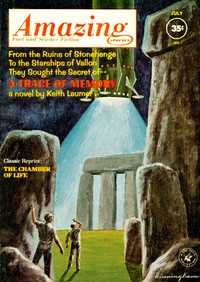
This digital edition of The blonde from Barsoom — Context and Discussion is described by source-level measurements including 6,142 words, 27 min estimated reading time, and 1 detected text section.
The text analysis averages about 18.4 words per sentence, while the detected sections provide another way to judge how the source is divided.
Project Gutenberg metadata also associates the work with “Science fiction,” connecting these edition facts with the source record’s subject description.
Explore this collection
These alternatives are selected using recorded categories and estimated reading time.
About 38 minutes
Fantasy Juvenile Worlds
8,735 recorded words. 11 minutes difference from this book's estimate.
View Gutenberg source #69601About 63 minutes
Fantasy Juvenile Worlds
14,437 recorded words. 36 minutes difference from this book's estimate.
View Gutenberg source #25165About 89 minutes
Fantasy Juvenile Worlds
20,393 recorded words. 62 minutes difference from this book's estimate.
View Gutenberg source #73181Search stored excerpts and compare books → Choose by your preferences →
Choices use stored catalog measurements. Estimates vary with reading speed. A shared category is a catalog label, not a claim that two books have the same argument or literary quality.
Search reads excerpt text stored with this catalog and links to its associated Gutenberg record. The connection is stored in the site database; this tool does not recheck that every excerpt is word-for-word identical to that external record. Excerpt search does not cover every chapter and does not verify historical publication dates.
Catalog snapshot checked: 2026-09-25. Coverage: 95 public books, 95 available source excerpts.
Read the complete public-domain text at its original source.
Read on Project GutenbergRobert F. Young's The Blonde from Barsoom opens with its protagonist, Harold Worthington Smith, standing on the ocher moss of a Martian dead-sea bottom, sword in hand, facing an oncoming Tark horde. But Harold is not on Mars—he is at his typewriter in an August afternoon apartment, his wife visiting her sister, the electric fan humming. The story immediately establishes a tension between the pulp Martian adventure Harold is writing and the mundane reality of his life as a struggling author. Young uses this split to craft a satire of Edgar Rice Burroughs pastiche, rejection-slip clichés, and the writer's fantasy of total identification with his hero.
Harold Worthington Smith is both the author and the protagonist of his own Martian story, thanks to his ability to achieve “total identification” with his characters. When Thon Carther the Earthman faces the Tarks, it is really Harold—tall, tanned, and handsome—standing there. Young uses this conceit to lampoon the wish-fulfillment at the heart of pulp science fiction. The editors' criticisms of Harold's work—stilted dialogue, dimensionally impossible heroines, unredeemed Burroughs influence—are quoted verbatim, and Harold's defensive rebuttals are equally precise. He argues that a 46-21-46 female is plausible on Mars, and that Burroughs influence is an essential ingredient. The story thus becomes a meta-commentary on the genre's conventions and the writer's ego.
The story's central conceit is that Harold's fictional world literally intrudes upon his real one. The Tark horde closing in corresponds to the clacking of his typewriter; the blond princess he rescues is described as “big-breasted” and “blond,” matching the cliché he defends. As the narrative progresses, the boundary dissolves: Harold's wife, initially a source of nagging, transforms into the princess, and the apartment study becomes a throne room. Young signals this shift through concrete details: the typewriter becomes solid gold, rejection slips become checks for $750, $2500, and $5000, and the wastebasket fills with “Long Thin Envelopes.” The phone rings with an editor from Mammalian Blonde Stories offering $10,000. The satire escalates as Harold nonchalantly stacks checks and tells his wife to put on clothes.
Young's humor relies on precise, recurring details. The wastebasket marked “Long Thin Envelopes” is a running gag—Harold empties it, but it fills again immediately. The editors' names are parodies of pulp magazines: Dead-Sea Bottom Stories, Red Planet Stories, Mammalian Blonde Stories. The story's structure mirrors Harold's own plot: a climactic battle, a rescue, and a reward. But the reward is not a princess—it is commercial success, measured in checks and obsequious editors. The ending, with Harold descending majestically to greet editors, completes the fantasy. Yet the story never fully abandons its ironic distance; the final line, “THE END,” is a wry acknowledgment of the artifice. Young's satire is affectionate but pointed, targeting both the writer's delusions and the genre's formulas.
Young's story rewards attention to its layered ironies: the way Harold's rejection-slip complaints become the very plot he lives, the way his wife's nagging transforms into adoration, and the way the typewriter's clack becomes the Tark horde's charge. Readers may enjoy tracking how each element of the opening criticism—stilted dialogue, dimensional heroines, Burroughs influence—is both acknowledged and subverted. The story is a compact, self-aware artifact of early 1960s science fiction, offering a glimpse into the genre's self-image.
I finished The Blonde from Barsoom and found myself thinking, oddly, about wishes. Harold's fantasy princess felt so real to him that she overstepped into his study — as if wanting something hard enough could call it forth. It reminded me of Five Children and It — Background and Themes, where the sand-fairy grants wishes and everyone learns how clumsy that longing can be. Both books seem to whisper that imagination has a mischievous side.
Build a private reading journal entry for this title.