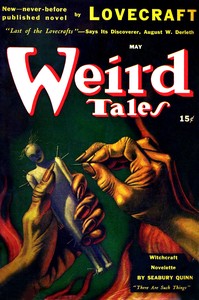
The novel opens not with Charles Ward himself, but with his disappearance from a private hospital, described in clinical detail: his face had 'a subtle cast which only the very aged usually acquire,' his voice was lost, and a birthmark had vanished while a new mole appeared. This medical prologue establishes a tone of detached observation that recurs throughout the excerpts, as the story is told through documents, letters, and reports rather than direct narration.
The structure immediately signals that this is a case to be pieced together, not a straightforward tale. The reader is positioned alongside the investigators, sifting through evidence of Ward's transformation and his connection to a 17th-century alchemist ancestor.
A Clinical Frame and a Missing Man
The first excerpt presents Ward's case through the eyes of doctors, cataloguing his physical anomalies: respiration and heart action had 'a baffling lack of symmetry,' digestion was 'incredibly prolonged,' and his skin was 'morbidly chill.' These details are not merely atmospheric; they ground the supernatural in pseudo-scientific observation, a hallmark of Lovecraft's method. The disappearance itself is treated as a puzzle, with the narrative withholding Ward's own perspective until later.
Readers should note how the opening refuses to explain—it only describes. The effect is to create a mystery that demands resolution, while also establishing that the truth will be uncovered through external evidence, not confession.
Letters and the Lure of the Past
Ward's letter to Dr. Willett, dated March 8, 1928, shifts the tone from clinical to desperate. He writes of 'a horror beyond all human conception' and pleads for help to 'thrust it back into the dark again.' The letter reveals his research into an ancestor, Joseph Curwen, and the 'Fenner letters' that describe a 'raiding party at Pawtuxet.' This is the first hint that Ward's madness is tied to historical events and forbidden knowledge.
The epistolary form is crucial: it gives Ward a voice while keeping him at a distance. His confession is incomplete, promising more when they meet, which never happens in the excerpts. This gap between what is said and what is withheld drives the reader's curiosity.
Anatomical Specimens and Official Silence
A later excerpt describes police discovering a 'hideous and shameful thing' in a cache, linked to Ward's bungalow. Ward and his colleague Dr. Allen deflect suspicion by claiming the specimens were for research, and the officials suppress the matter to avoid 'monstrous effect on public sentiment and national dignity.' The narrative here is deliberately vague—the exact nature of the specimens is never stated, only hinted at through the reaction of the authorities.
This episode exemplifies Lovecraft's technique of horror through omission. The reader is left to imagine what could be so disturbing that even the police and federal agents choose to bury it. The focus is not on the grotesque detail but on the institutional cover-up, which amplifies the sense of dread.
The Ancestor's Shadow: Alchemy and Identity
The epigraph from Borellus, quoted at the start, describes raising 'the Shape of any dead Ancestour' from salts, and the chapter titles—'A Search and an Evocation,' 'A Mutation and a Madness'—suggest that Ward's research into alchemy leads to a literal reanimation. The excerpts show Ward's physical changes mirroring those of his ancestor: the loss of his birthmark, the aged appearance, the altered voice. This blurring of identity is the core horror.
Readers should watch for how the narrative uses documents—letters, medical reports, historical records—to create a layered investigation. The truth is never directly shown; it is assembled from fragments, leaving much to inference.
The excerpts present a novel that is as much about the process of discovery as about the horror itself. Lovecraft builds tension through accumulation of detail, not revelation. Readers who attend to the physical symptoms, the letters, and the gaps in official accounts will find a story that rewards careful reading. The case of Charles Dexter Ward is not solved; it is documented, and the documentation is the terror.
I’ve held both close, these many years. Ward’s grim descent into decaying parchment whispers reminds me of the softer, sunlit mystery in The Treasure of the Isle of Mist — Inside the Classic—two searches for what lies beneath, one shadowed, one bright, yet sharing that quiet ache of old things calling us home.