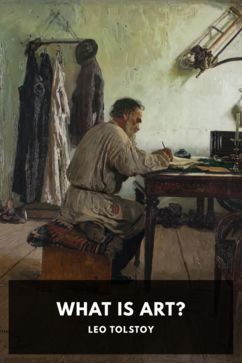
What Is Art? - Leo Tolstoy

(13 User reviews)   2402
By Nicholas Ortiz Posted on Jan 27, 2026
In Category - Justice Studies
Leo Tolstoy Leo Tolstoy
English
Okay, so you know that feeling when you look at a modern art piece and think, 'My toddler could have done that'? Or when someone raves about a classic novel that just bored you to tears? Leo Tolstoy, the guy who wrote those giant Russian novels, felt that way too. In 'What Is Art?', he throws down the gauntlet. He basically asks: if something doesn't genuinely move people or bring us together, is it really art at all, or just a fancy, expensive trick? This book is his fiery, personal, and sometimes infuriating answer. He takes on the entire art world—from opera houses to poetry slams—and argues that true art isn't about beauty or technique, but about infectious emotional connection. It's a wild, opinionated ride that will make you question every painting, song, and book you've ever loved (or hated). Get ready to have your definitions completely wrecked.
Share

Read "What Is Art? - Leo Tolstoy" Online

This book is available in the public domain. Start reading the digital edition below.

START READING FULL BOOK
Instant Access    Mobile Friendly

Book Preview

A short preview of the book’s content is shown below to give you an idea of its style and themes.

their blind faith, though she herself disbelieved the church doctrines. “Their lives are so poor and bare—they have so little art, so little poetry and colour in their lives—let them at least enjoy what they have; it would be cruel to undeceive them,” said she. A false and antiquated view of life is supported by means of art, and is inseparably linked to some manifestations of art which we enjoy and prize. If the false view of life be destroyed this art will cease to appear valuable. Is it best to screen the error for the sake of preserving the art? Or should the art be sacrificed for the sake of truthfulness? Again and again in history a dominant church has utilised art to maintain its sway over men. Reformers (early Christians, Mohammedans, Puritans, and others) have perceived that art bound people to the old faith, and they were angry with art. They diligently chipped the noses from statues and images, and were wroth with ceremonies, decorations, stained-glass windows, and processions. They were even ready to banish art altogether, for, besides the superstitions it upheld, they saw that it depraved and perverted men by dramas, drinking-songs, novels, pictures, and dances, of a kind that awakened man’s lower nature. Yet art always reasserted her sway, and to-day we are told by many that art has nothing to do with morality—that “art should be followed for art’s sake.” I went one day, with a lady artist, to the Bodkin Art Gallery in Moscow. In one of the rooms, on a table, lay a book of coloured pictures, issued in Paris and supplied, I believe, to private subscribers only. The pictures were admirably executed, but represented scenes in the private cabinets of a restaurant. Sexual indulgence was the chief subject of each picture. Women extravagantly dressed and partly undressed, women exposing their legs and breasts to men in evening dress; men and women taking liberties with each other, or dancing the “can-can,” etc., etc. My companion the artist, a maiden lady of irreproachable conduct and reputation, began deliberately to look at these pictures. I could not let my attention dwell on them without ill effects. Such things had a certain attraction for me, and tended to make me restless and nervous. I ventured to suggest that the subject-matter of the pictures was objectionable. But my companion (who prided herself on being an artist) remarked with conscious superiority, that from an artist’s point of view the _subject_ was of no consequence. The pictures being very well executed were artistic, and therefore worthy of attention and study. Morality had nothing to do with art. Here again is a problem. One remembers Plato’s advice not to let our thoughts run upon women, for if we do we shall think clearly about nothing else, and one knows that to neglect this advice is to lose tranquillity of mind; but then one does not wish to be considered narrow, ascetic, or inartistic, nor to lose artistic pleasures which those around us esteem so highly. Again, the newspapers last year printed proposals to construct a Wagner Opera House, to cost, if I recollect rightly, £100,000—about as much as a hundred labourers may earn by fifteen or twenty years’ hard work. The writers thought it would be a good thing if such an Opera House were erected and endowed. But I had a talk lately with a man who, till his health failed him, had worked as a builder in London. He told me that when he was younger he had been very fond of theatre-going, but, later, when he...

This is a limited preview. Download the book to read the full content.

Forget everything you think you know about art galleries, concert halls, and literature classes. In 'What Is Art?', Leo Tolstoy isn't giving a dry lecture; he's starting a bar fight about culture. Written later in his life, this is the work of a man deeply frustrated with the art of his time, which he saw as an exclusive club for the rich and educated, completely disconnected from ordinary people.

The Story

There isn't a plot with characters, but there's a powerful argument. Tolstoy systematically dismantles common definitions of art as 'beauty' or 'pleasure.' He thinks those ideas are vague and selfish. Instead, he builds his own case: real art is a form of communication. An artist feels a strong emotion, and through their work—a painting, a song, a story—they 'infect' the viewer or reader with that same feeling. If it doesn't create that shared emotional bridge, it fails as art. He uses this rule to judge everything. He famously dismisses his own later novels, much of Shakespeare, and most classical music as 'bad art' because he finds them unclear or elitist. In their place, he champions folk tales, simple hymns, and stories that plainly convey universal feelings like compassion or joy.

Why You Should Read It

You should read this not because Tolstoy is 'right,' but because he is so brilliantly, stubbornly provocative. He forces you to defend your own tastes. Why DO you love that obscure indie film? Why does that pop song on the radio actually move you? His core idea—that art's power is in shared feeling—is incredibly compelling and democratic. It cuts through pretension. While you'll likely disagree with many of his harsh judgments (calling Beethoven's Ninth Symphony 'bad art' is a tough sell), the process of disagreeing is where the magic happens. It makes you a more active, thoughtful consumer of all creative work.

Final Verdict

This book is perfect for anyone who has ever felt confused or left out by the 'official' art world, or for creatives who want to think deeply about why they make what they make. It's also great for book clubs—it's guaranteed to spark a heated debate. If you want a calm, academic survey of aesthetics, look elsewhere. But if you want a passionate, personal, and challenging manifesto that will permanently change how you see, hear, and feel art, Tolstoy's fiery little book is essential reading.


🔖 Legacy Content

This historical work is free of copyright protections. You do not need permission to reproduce this work.

Susan Thompson
1 year ago

Having read this twice, the content flows smoothly from one chapter to the next. Worth every second.

Richard Anderson
6 months ago

Without a doubt, the character development leaves a lasting impact. Definitely a 5-star read.

Sandra Brown
9 months ago

I didn't expect much, but the character development leaves a lasting impact. A true masterpiece.

Logan Perez
4 months ago

Just what I was looking for.

Carol Gonzalez
6 months ago

This book was worth my time since the narrative structure is incredibly compelling. I couldn't put it down.
5
5 out of 5 (13 User reviews )

Add a Review

Your Rating *
There are no comments for this eBook.
You must log in to post a comment.
Log in


Related eBooks