About 313 minutes
The Golden Book of Springfield — Edition Insights
Science Fiction Utopias
71,764 recorded words. 4 minutes difference from this book's estimate.
View Gutenberg source #59860
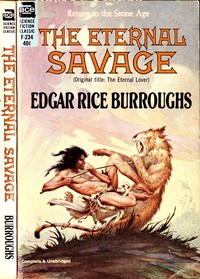
The source record for The eternal savage — Key Ideas to Explore measures this digital text at 72,845 words, 5 hr 17 min estimated reading time, and 6 detected text sections.
The text analysis averages about 19.2 words per sentence, while the detected sections provide another way to judge how the source is divided.
Project Gutenberg metadata also associates the work with “Science fiction,” connecting these edition facts with the source record’s subject description.
Explore this collection
These alternatives are selected using recorded categories and estimated reading time.
About 313 minutes
Science Fiction Utopias
71,764 recorded words. 4 minutes difference from this book's estimate.
View Gutenberg source #59860About 329 minutes
Science Fiction Utopias
75,530 recorded words. 12 minutes difference from this book's estimate.
View Gutenberg source #2875About 367 minutes
Science Fiction Utopias
84,392 recorded words. 50 minutes difference from this book's estimate.
View Gutenberg source #2874Search stored excerpts and compare books → Choose by your preferences →
Choices use stored catalog measurements. Estimates vary with reading speed. A shared category is a catalog label, not a claim that two books have the same argument or literary quality.
Search reads excerpt text stored with this catalog and links to its associated Gutenberg record. The connection is stored in the site database; this tool does not recheck that every excerpt is word-for-word identical to that external record. Excerpt search does not cover every chapter and does not verify historical publication dates.
Catalog snapshot checked: 2026-09-25. Coverage: 95 public books, 95 available source excerpts.
Read the complete public-domain text at its original source.
Read on Project GutenbergThe narrative begins in the Niocene Age with Nu, son of Nu, hunting the saber-toothed tiger Oo to prove himself worthy of Nat-ul, who demands the fangs as a condition for mating. Burroughs establishes a sensory-rich prehistoric world: Nu's nostrils test the breeze for Oo, and his muscles roll beneath bronzed skin. The prose shifts between Nat-ul's spoken conditions and Nu's internal resolve, blending romance with survival.
Later excerpts introduce a modern African setting, where Victoria Custer appears as a guest of Tarzan. The transition is abrupt: Nu follows Nat-ul's footprints on a beach only to find them vanish mid-stride, while a stranger's dugout canoe suggests a connection between eras. These early sections set up a dual timeline without explicit explanation, leaving the mechanism of time displacement ambiguous.
The opening pages immerse the reader in Nu's perception: his nostrils question vagrant breezes, his senses catch the odor of Ta the woolly rhinoceros, and he moves silently through the jungle primeval. Burroughs uses specific animal names—Oo, Ta, the saber-tooth—to build a taxonomy of threat. Nu's hunt is motivated by Nat-ul's condition that only the mightiest hunter may claim her, a social dynamic that ties romance directly to physical prowess.
Notably, the prose emphasizes Nu's youth: he has not yet grown a man's beard, yet he seeks to slay the most dangerous predator. The dialogue between Nu and Nat-ul reveals her desire for pride and respect alongside love, framing the hunt as both a test and a gift. This section establishes a world where status is earned through tangible feats, and where the environment is alive with specific, named dangers.
A key structural moment occurs when Nu tracks Nat-ul's footprints along a beach. The trail ends abruptly—midway between ocean and jungle, with no sign of doubling back, entering the water, or approaching the treeline. Burroughs writes that the footprints simply ceased, as if Nat-ul were swallowed by a hole in the beach. Nu, bewildered, searches for any trace but finds none.
This passage is notable for its restraint: Nu does not invoke supernatural explanations; instead, he turns to the nearest material cause—the man who had pursued her. The footprints of that man stop a hundred paces behind Nat-ul's, and his spoor indicates he returned unburdened. The scene leaves a literal gap in the narrative, a puzzle that the reader must hold alongside the later introduction of Victoria Custer. The beach becomes a threshold between worlds, though the text does not yet explain how.
Nu observes the Boat Builders, a group of strangers who fell trees and scoop out canoes using fire. Burroughs details their method: fires kindled in hollowed trunks eat away softer wood while hardening the exterior, producing light, staunch dugouts. One man, Tur, launches his boat through the surf, paddling out to sea toward distant islands. Nu watches with wide eyes, recognizing the skill and courage required.
This section introduces a second culture within the prehistoric setting, contrasting with Nu's tribe. The Boat Builders' technology—burning and scooping—is primitive yet effective, and their willingness to venture onto the water hints at exploration. Nu's desire to explore the islands of mystery is mentioned, linking his personal ambition to the larger theme of crossing boundaries. The dugout canoe, a simple craft, becomes a symbol of possible connection between separated worlds.
The excerpts provide only fragments of Victoria Custer's story, but they establish a clear shift in perspective from Nu's prehistoric world to a modern African setting. The catalog lists Victoria as a guest of Tarzan, seeking vacation and adventure. Her introduction is brief, but the narrative structure implies that she will encounter Nu through some form of time displacement.
Notably, the text does not explain the mechanism of this transition within the provided excerpts. The vanishing footprints and the dugout canoe suggest a portal or rift, but Burroughs leaves the connection implicit. Readers must infer that the two storylines will converge, likely through a natural catastrophe as hinted in the book's blurb. This structural choice places the burden of connection on the reader, rewarding attention to recurring motifs like footprints, water, and the sea.
As you read, pay close attention to how Burroughs uses sensory details—smells, sounds, and physical sensations—to differentiate the prehistoric and modern settings. The vanishing footprints and the dugout canoe are early clues to the time-crossing premise, but the narrative withholds explicit explanation. Consider how each character's motivations (Nu's hunt for status, Victoria's search for adventure) mirror each other across eras, and how the beach functions as a liminal space where rules of reality bend.
That book left me thinking about how strange it is when two worlds touch—a hunter’s footprints vanishing on a beach, while someone modern finds them gone. It felt like time shifting quietly. For some reason, I remembered the gentle ache in The Last Laugh — Text and Context afterward. Both stayed with me, like a soft echo I couldn’t quite place.
Answer a few questions and save a private reflection on this device.