About 317 minutes
The eternal savage — Key Ideas to Explore
Science Fiction Utopias
72,845 recorded words. 12 minutes difference from this book's estimate.
View Gutenberg source #70002

Before opening Personal Recollections of Joan of Arc — Volume 2 — Reading Notes, the edition data offers a quick orientation: 75,530 words, 5 hr 29 min estimated reading time, and 10 detected text sections.
The text analysis averages about 20.5 words per sentence, while the detected sections provide another way to judge how the source is divided.
Project Gutenberg metadata also associates the work with “Joan, of Arc, Saint, 1412-1431 -- Fiction,” connecting these edition facts with the source record’s subject description.
Explore this collection
These alternatives are selected using recorded categories and estimated reading time.
About 317 minutes
Science Fiction Utopias
72,845 recorded words. 12 minutes difference from this book's estimate.
View Gutenberg source #70002About 313 minutes
Science Fiction Utopias
71,764 recorded words. 16 minutes difference from this book's estimate.
View Gutenberg source #59860About 367 minutes
Science Fiction Utopias
84,392 recorded words. 38 minutes difference from this book's estimate.
View Gutenberg source #2874Search stored excerpts and compare books → Choose by your preferences →
Choices use stored catalog measurements. Estimates vary with reading speed. A shared category is a catalog label, not a claim that two books have the same argument or literary quality.
Search reads excerpt text stored with this catalog and links to its associated Gutenberg record. The connection is stored in the site database; this tool does not recheck that every excerpt is word-for-word identical to that external record. Excerpt search does not cover every chapter and does not verify historical publication dates.
Catalog snapshot checked: 2026-09-25. Coverage: 95 public books, 95 available source excerpts.
Read the complete public-domain text at its original source.
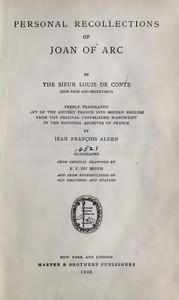
Read on Project GutenbergThe narrator, Sieur Louis de Conte, establishes himself as a witness to history from the first chapter, writing from Joan's dictation in a private office. The early excerpts show Joan laughing off danger, calling cannon-fire "not any danger" while Catherine Boucher pleads for her to lead fewer assaults. This domestic scene—a friend's worry, Joan's deflection—sets a tone of intimate concern that will later sharpen into horror as the trial begins.
Twain's framing device, a "freely translated" manuscript from the National Archives, gives the story an air of recovered authenticity. But the narrator's voice is anything but neutral: he calls the judges "hard hearts" and describes their "cruel eagerness." Readers should watch how this emotional filter colors every event, from the Red Field of Patay to the courtroom traps.
De Conte does not merely report; he reacts. When Joan answers the question about Grace, he writes: "Ah, you will never see an effect like that; no, not while you live." This is not a historian's detachment but a participant's awe. He names Jean Lefevre as "one of the honorable brave men" and describes Cauchon's face "flushed black with anger." These judgments prime the reader to see the trial as a persecution, not a legal proceeding.
The narrator's presence is most felt in moments of tension. During the trap about Grace, he says "it seemed a year" while waiting for Joan's reply. Such temporal exaggeration signals his emotional investment. Readers should note that de Conte's perspective is limited—he cannot know Joan's inner thoughts, only her words and his own feelings. This creates a portrait that is admiring but not omniscient.
Joan's speech in the excerpts is consistently plain and unadorned. To Catherine's plea for caution, she says: "I was not in any danger." In court, she answers the question about a woman's dress with a condition: "if I may go out from this prison—but here, no." Her most famous line—"If I be not in a state of Grace, I pray God place me in it"—is reported as a humble, gentle utterance, not a rhetorical flourish.
Twain contrasts this simplicity with the court's complexity. The judges ask "tedious and empty questions" about her Voices' eyes and light. Joan's replies are short, often repeating that she has "sworn enough." This asymmetry—plain truth versus legalistic trickery—is the book's central dramatic engine. The reader is invited to admire Joan's steadfastness while recognizing the trap she cannot see.
The excerpts portray the trial as a deliberate snare. The priest Beaupere "slid indifferently away" from a remark, then "sprang his trap" with the question about Grace. The narrator calls this "craft and artifice" and notes that the court watched "with a cruel eagerness." The legal contract limiting the examination is ignored; Cauchon commands Joan to swear again despite her protests.
Twain emphasizes the unfairness: fifty experts against a novice, a court "reorganized for assassination." The chapter titles themselves—"Weaving the Net About Her," "All Ready to Condemn"—frame the trial as predetermined. Yet the excerpts show Joan holding her ground, refusing to take the oath without reservations. The drama lies not in whether she will be condemned, but in how she will resist.
In one of the trial's most poignant moments, Beaupere asks Joan about her childhood: the oak wood, the fairies, the games under the "Arbre Fee Bourlemont." The narrator notes that "this stirring up of old memories broke her voice and made her cry a little." This is a tactical move by the court—softening her with nostalgia—but it also reveals Joan's humanity.
The contrast is stark: the same girl who laughed at cannon-fire now weeps at the memory of a tree. Twain uses this to remind readers that Joan is young, homesick, and trapped. The fairies and games belong to a world she has lost. The court's cruelty lies not only in its legal traps but in its willingness to exploit her past. This section deepens the portrait beyond the warrior-saint to a vulnerable person.
Readers approaching this volume should pay attention to the gap between what Joan says and what the narrator tells us. De Conte's admiration is clear, but his account is also a plea for sympathy. The trial scenes reward close reading: every question is a move in a deadly game, and Joan's answers, however simple, are acts of defiance. The book's power lies not in suspense—the outcome is known—but in the texture of the struggle.
Rain fell against the window while I turned the pages of Twain’s Joan, watching her simple faith outmaneuver clever traps. Afterwards, restless, I picked up another set of notes, a quieter story about endurance. It wasn’t a battlefield, but somehow the same stubborn courage lived there, in a different century, under a gentler sky. Ride the Crepe Ring — Reading Notes stayed with me long after the rain stopped.
Use these questions to collect your thoughts before moving on.