About 389 minutes
The dream: A novel — Text and Context
Science Fiction Utopias
89,343 recorded words. 22 minutes difference from this book's estimate.
View Gutenberg source #69394
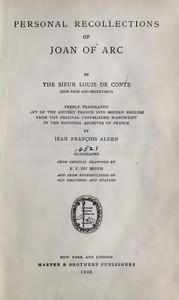
This digital edition of Personal Recollections of Joan of Arc — Volume 1 — Context and Discussion is described by source-level measurements including 84,392 words, 6 hr 7 min estimated reading time, and 10 detected text sections.
The text analysis averages about 22.2 words per sentence, while the detected sections provide another way to judge how the source is divided.
Project Gutenberg metadata also associates the work with “Joan, of Arc, Saint, 1412-1431 -- Fiction,” connecting these edition facts with the source record’s subject description.
Explore this collection
These alternatives are selected using recorded categories and estimated reading time.
About 389 minutes
Science Fiction Utopias
89,343 recorded words. 22 minutes difference from this book's estimate.
View Gutenberg source #69394About 391 minutes
Science Fiction Utopias
89,861 recorded words. 24 minutes difference from this book's estimate.
View Gutenberg source #66409About 393 minutes
Science Fiction Utopias
90,235 recorded words. 26 minutes difference from this book's estimate.
View Gutenberg source #71806Search stored excerpts and compare books → Choose by your preferences →
Choices use stored catalog measurements. Estimates vary with reading speed. A shared category is a catalog label, not a claim that two books have the same argument or literary quality.
Search reads excerpt text stored with this catalog and links to its associated Gutenberg record. The connection is stored in the site database; this tool does not recheck that every excerpt is word-for-word identical to that external record. Excerpt search does not cover every chapter and does not verify historical publication dates.
Catalog snapshot checked: 2026-09-25. Coverage: 95 public books, 95 available source excerpts.
Read the complete public-domain text at its original source.
Read on Project GutenbergMark Twain’s Personal Recollections of Joan of Arc — Volume 1 opens with a cascade of framing devices: a translator’s preface, a note on Joan’s peculiar history, and the claim that the narrative is a translation of an unpublished manuscript by the Sieur Louis de Conte, her page and secretary. This layered structure immediately distances the reader from direct access to Joan, filtering her story through a male narrator who both venerates and interprets her. The work is not a straightforward biography but a deliberate construction of memory, complete with a list of historical authorities cited for verification. Twain’s Joan emerges not from the author’s own voice but from a web of testimonies, a choice that shapes every scene.
The book’s opening pages establish a complex narrative architecture. A “Translator’s Preface” by the fictional Jean Francois Alden explains the need to judge historical figures by their own era’s standards. Then a separate note, “A Peculiarity of Joan of Arc’s History,” highlights her unique achievement of commanding armies at seventeen. Only after these preliminaries does the supposed memoir begin, with Louis de Conte introducing himself. This triple frame—Twain writing as Alden translating de Conte—creates a deliberate distance. The reader is always aware that Joan’s story is being mediated, remembered, and possibly shaped by her devoted page. The effect is to make the narrative feel like a relic, a document unearthed from archives, rather than a novel. Twain never lets us forget that we are reading a recollection, not an eyewitness account.
The narrative moves between two sharply contrasting settings: the pastoral village of Domremy and the political labyrinth of the French court. Early chapters dwell on the “Fairy Tree of Domremy” and the simple life of shepherds, where Joan is described as “all aflame with love of France.” The language here is warm, unhurried, filled with communal rituals. But once Joan leaves for Chinon, the tone shifts. The court is a place of “guarded phrases, colorless and non-committal,” where kings and bishops speak in careful half-truths. Twain emphasizes this contrast through Joan’s own speech: in Domremy she talks freely; at court she becomes “very candid, but not given to talking.” The movement from open fields to closed chambers mirrors her loss of innocence and the tightening grip of political scrutiny. The reader experiences this shift as a physical passage from light into shadow.
One striking pattern in the excerpts is the use of water imagery to describe Joan’s effect on others. When the King hears her plain speech, Twain writes that it is “like fresh cold water from the mountains to parched lips used to the water of the sun-baked puddles of the plain.” This simile recurs in spirit throughout the narrative: Joan is repeatedly associated with purity, refreshment, and natural force. The bishops, by contrast, are “cautious,” “prying,” and “wearisome” in their questioning. The image of thirst suggests a court dying for lack of honesty, and Joan as the source that revives it. This motif is not merely decorative; it ties Joan’s character to elemental simplicity, reinforcing the idea that her power lies in being untouched by artifice. The reader should watch for variations on this theme—wells, rivers, rain—as the story progresses.
Louis de Conte, the narrator, is both insider and worshiper. He was Joan’s page and secretary, present at many key moments, yet his adoration colors every observation. In the excerpts, he describes Joan’s horsemanship and her “naive way” of speaking to the King, always with reverent astonishment. But his position also imposes limits: he cannot know what Joan thinks when alone, nor what the bishops truly intend. Twain exploits this limitation to create suspense. The reader sees Joan only through de Conte’s eyes, which means we share his blind spots. When the bishops report that Joan is “gentle and simple,” de Conte adds wryly that she had “a tongue that could go fast enough when no harm could come of her words.” This small revelation hints at a Joan more complex than the page’s idealization. The narrative thus becomes as much about the act of remembering as about the remembered figure.
Readers approaching this first volume should attend to the gaps between what de Conte tells us and what he might be omitting. Twain’s Joan is a character constructed from devotion, but the framing devices invite skepticism. The book rewards attention to its structure—the way scenes are arranged, the recurrence of certain images, the shifts in tone between Domremy and court. Treat the narrator as a character in his own right, and the story becomes a meditation on how legends are made.
Reading about Joan's quiet certainty amidst court noise, I thought of my grandmother’s stubborn faith, and how Jonah of the Jove-Run once carried that same intimate weight—not grand, but profoundly personal, like hearing a familiar voice in a crowded room and remembering what home sounds like. Jonah of the Jove-Run — Reading Notes lingered with me the same way.
A brief reflection can help important ideas stay with you longer.