About 37 minutes
My sweetheart's the Man in the Moon — Reading Notes
Science Fiction Utopias
8,409 recorded words. 1 minutes difference from this book's estimate.
View Gutenberg source #68393
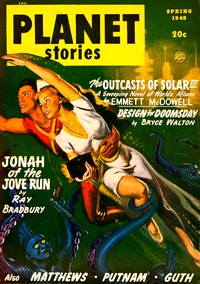
This digital edition of Jonah of the Jove-Run — Reading Notes is described by source-level measurements including 8,701 words, 38 min estimated reading time, and 1 detected text section.
The text analysis averages about 11.3 words per sentence, while the detected sections provide another way to judge how the source is divided.
Project Gutenberg metadata also associates the work with “Science fiction,” connecting these edition facts with the source record’s subject description.
Explore this collection
These alternatives are selected using recorded categories and estimated reading time.
About 37 minutes
Science Fiction Utopias
8,409 recorded words. 1 minutes difference from this book's estimate.
View Gutenberg source #68393About 39 minutes
Science Fiction Utopias
8,894 recorded words. 1 minutes difference from this book's estimate.
View Gutenberg source #73358About 41 minutes
Science Fiction Utopias
9,210 recorded words. 3 minutes difference from this book's estimate.
View Gutenberg source #72248Search stored excerpts and compare books → Choose by your preferences →
Choices use stored catalog measurements. Estimates vary with reading speed. A shared category is a catalog label, not a claim that two books have the same argument or literary quality.
Search reads excerpt text stored with this catalog and links to its associated Gutenberg record. The connection is stored in the site database; this tool does not recheck that every excerpt is word-for-word identical to that external record. Excerpt search does not cover every chapter and does not verify historical publication dates.
Catalog snapshot checked: 2026-09-25. Coverage: 95 public books, 95 available source excerpts.
Read the complete public-domain text at its original source.
Read on Project GutenbergRay Bradbury's 'Jonah of the Jove-Run' opens with a striking image of neglect: Nibley, a very old man with a 'slack-gummed face' and eyes like 'crayfish,' stands unwanted on Marsport while the crew of the supply ship TERRA waits for a repair rocket. His first spoken line—'They don't want me, or need me'—establishes a tension between his useless appearance and his hidden power. The story immediately pits the crew's hard, mechanical faith against Nibley's intuitive knowledge, as he calmly announces the rocket's crash before anyone else knows. This contrast between the old man's frail body and his 'crazy cosmic brain' sets up the central conflict: a society that values machines over human experience, and a man who must prove his worth through the very ability they dismiss.
Bradbury builds the crew's contempt through physical and verbal details. Nibley is described as 'a very old man, with a slack-gummed face' and 'eyes like the little bubbly stalks of crayfish'—a simile that reduces him to a creature of the margins. The astrogator's curt dismissal—'Go away, old man'—and the crew's refusal to listen to his truth about the crashed rocket show a world that has no use for intuition. Yet Nibley's own speech reveals a self-awareness that undercuts his apparent foolishness: 'Machines are better, nowadays. Why should they want an old man like me with a taste for Martian liquor?' This line, spoken to himself, hints at a deeper sorrow and a history of being wronged. The story's tension hinges on whether the crew's need will overcome their prejudice.
Nibley's physical decline is measured against his mental acuity. When he is injured and carried to a bunk, the crew's dismay is palpable: 'They were tired. They didn't want to live any more.' But Nibley, weakening, insists he has 'two orbits to fix'—one for the ship to Jupiter, and one for his own 'separate secret personal orbit.' His body is a 'ninety pounds of bone,' yet he demands a bulger and a stretcher to be taken to an asteroid. The doctor's 'probings and fixings' underscore his fragility, while his wheezy laughter and memories of predicting baseball windows show a lifetime of being disbelieved. The story uses his failing body to heighten the stakes: his final computation must outlast his own life.
A recurring pattern in the excerpts is Nibley's history of being called a liar for telling the truth. He recalls his father threatening the woodshed for claiming a meteor fell on a garage six miles away—only to later discover he was right. 'I lied like hell and everybody said I lied like hell, but come to find out, later, I wasn't lyin' at all, it was the truth. I just sensed things.' This paradox—that his gift is indistinguishable from a tall tale—places him in a long line of Bradbury characters whose inner vision is dismissed by a pragmatic world. The story does not resolve whether his ability is supernatural or a heightened natural sense; it simply presents his certainty against the crew's doubt. The note he scribbles for Bruno, marked 'Personal. Don't pry into it yourself,' suggests a final truth that will outlast him.
Readers should pay close attention to how Bradbury uses Nibley's voice—a mix of self-deprecation, defiance, and folk wisdom—to create a character who is both pathetic and heroic. The story's brevity (under 9,000 words) means every detail counts, from the Martian setting to the crew's collective despair. Notice how the title's biblical allusion (Jonah) frames Nibley as a reluctant prophet, swallowed not by a whale but by a ship of skeptics. The ending, though not fully shown in these excerpts, is foreshadowed by his 'secret personal orbit'—a trajectory that may redeem his life of neglect.
Reading about Jonah’s lonely accuracy reminded me of my grandfather’s last years, how his blurry warnings were ignored until too late. There’s a particular ache in being right when no one wants you to be. That same ache surfaced in I'll See You in My Dreams — Reading Notes, where foresight becomes a quiet haunting rather than a triumph.
Answer a few questions and save a private reflection on this device.