About 29 minutes
Cool air — Key Ideas to Explore
Historical Psychological Social Fiction
6,579 recorded words. 21 minutes difference from this book's estimate.
View Gutenberg source #73177
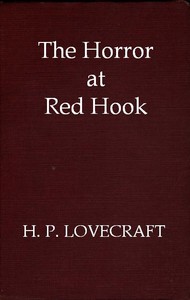
The source record for The horror at Red Hook — A Reader’s Guide measures this digital text at 11,489 words, 50 min estimated reading time, and 2 detected text sections.
The text analysis averages about 29.8 words per sentence, while the detected sections provide another way to judge how the source is divided.
Project Gutenberg metadata also associates the work with “Short stories,” connecting these edition facts with the source record’s subject description.
Explore this collection
These alternatives are selected using recorded categories and estimated reading time.
About 29 minutes
Historical Psychological Social Fiction
6,579 recorded words. 21 minutes difference from this book's estimate.
View Gutenberg source #73177About 28 minutes
Historical Psychological Social Fiction
6,218 recorded words. 22 minutes difference from this book's estimate.
View Gutenberg source #76857About 206 minutes
Historical Psychological Social Fiction
47,245 recorded words. 156 minutes difference from this book's estimate.
View Gutenberg source #244Search stored excerpts and compare books → Choose by your preferences →
Choices use stored catalog measurements. Estimates vary with reading speed. A shared category is a catalog label, not a claim that two books have the same argument or literary quality.
Search reads excerpt text stored with this catalog and links to its associated Gutenberg record. The connection is stored in the site database; this tool does not recheck that every excerpt is word-for-word identical to that external record. Excerpt search does not cover every chapter and does not verify historical publication dates.
Catalog snapshot checked: 2026-09-25. Coverage: 95 public books, 95 available source excerpts.
Read the complete public-domain text at its original source.
Read on Project GutenbergThe story opens not with the titular neighborhood but with a seemingly mundane incident in rural Rhode Island: a large, capable-looking man suffers a hysterical breakdown at the sight of a brick building. This man is Thomas F. Malone, a New York police detective on medical leave after a traumatic raid. Lovecraft immediately establishes a frame narrative of psychological fragility, hinting that the horrors to come have already left their mark. The reader is thus primed to view the subsequent events through the lens of a damaged but reliable witness, whose professional skepticism will be tested by what he uncovers.
The opening section introduces Malone as a man whose sanity has been shaken by a case involving collapsing buildings and mass death. Lovecraft uses this to create a sense of unreliability: the reader must decide how much of the horror is supernatural and how much is the product of a traumatized mind. The detective's fear of brick buildings becomes a recurring motif, linking his psychological state to the physical environment of Red Hook. This framing device is crucial for a first reading, as it encourages attention to Malone's perceptions and the gradual erosion of his rational worldview.
The middle excerpt shifts to a maritime scene involving the mysterious Robert Suydam and his bride. A cryptic note demands that Suydam's body be handed over to Arab sailors, and the doctor discovers that Mrs. Suydam's blood has been drained. Lovecraft's prose here is clinical, focusing on the doctor's reticence and the sailors' bulging pockets. The reader is left with unanswered questions: What happened in the stateroom? Why the need for secrecy? This section demonstrates Lovecraft's skill at suggesting horror through omission, and it invites the reader to piece together clues alongside Malone, who remains unaware of these events until later.
The final excerpt returns to Malone, now active in Red Hook during a police raid. The description is dense with sensory details: spattered blood, braziers, incense, and a charnal odor. Lovecraft emphasizes the chaos of the raid and the deliberate destruction of evidence, such as objects thrown down shafts. Malone's focus on Suydam's basement flat, with its books, instruments, and gold ingots, suggests a cult leader's lair. The reader is left with a sense of incomplete revelation—much is lost in the mêlée, and the full extent of the horror remains tantalizingly out of reach.
Throughout these excerpts, Lovecraft withholds key information, forcing the reader to infer from fragments. The narrative structure—beginning with aftermath, then moving to events unknown to the protagonist—creates dramatic irony. A first-time reader should pay close attention to the details that Malone himself might overlook: the negroid mouth of the Arab sailor, the glass-stoppered bottles, the lean, black-and-white cat. These small observations accumulate, building a picture of a hidden world beneath the surface of Red Hook. The story rewards careful reading and a willingness to embrace ambiguity.
Lovecraft's tale is best approached as a puzzle box, where the horror lies in what is glimpsed rather than explained. The reader is invited to share Malone's disorientation and to draw their own conclusions from the evidence presented. The frame narrative of psychological trauma serves as both a warning and a lens: the horrors of Red Hook may be supernatural, or they may be the product of a mind pushed to its limits. Either way, the story's power lies in its ability to unsettle without fully revealing its secrets.
Reading The Horror at Red Hook left me with that heavy, quiet unease—the way Malone’s dread stays lodged long after the raid ends. I sat with that feeling for days, and it reminded me of how Droll Stories — Volume 2 — Context and Discussion holds its own lingering texture, though lighter, more wry. Both linger not in plot, but in the mood they leave behind.
Your answers remain private and are stored only in this browser.