About 267 minutes
Droll Stories — Volume 1 — Context and Discussion
Historical Psychological Social Fiction
61,282 recorded words. 0 minutes difference from this book's estimate.
View Gutenberg source #1925
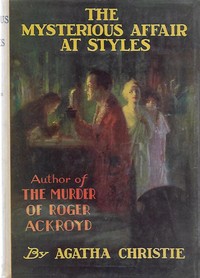
The catalog record for The Mysterious Affair at Styles — Reading Companion provides practical reading context through 61,319 words, 4 hr 27 min estimated reading time, and 14 detected text sections.
The text analysis averages about 11.4 words per sentence, while the detected sections provide another way to judge how the source is divided.
Project Gutenberg metadata also associates the work with “Private investigators -- England -- Fiction,” connecting these edition facts with the source record’s subject description.
Explore this collection
These alternatives are selected using recorded categories and estimated reading time.
About 267 minutes
Historical Psychological Social Fiction
61,282 recorded words. 0 minutes difference from this book's estimate.
View Gutenberg source #1925About 271 minutes
Historical Psychological Social Fiction
62,291 recorded words. 4 minutes difference from this book's estimate.
View Gutenberg source #2318About 253 minutes
Historical Psychological Social Fiction
58,004 recorded words. 14 minutes difference from this book's estimate.
View Gutenberg source #2551Search stored excerpts and compare books → Choose by your preferences →
Choices use stored catalog measurements. Estimates vary with reading speed. A shared category is a catalog label, not a claim that two books have the same argument or literary quality.
Search reads excerpt text stored with this catalog and links to its associated Gutenberg record. The connection is stored in the site database; this tool does not recheck that every excerpt is word-for-word identical to that external record. Excerpt search does not cover every chapter and does not verify historical publication dates.
Catalog snapshot checked: 2026-09-25. Coverage: 95 public books, 95 available source excerpts.
Read the complete public-domain text at its original source.
Read on Project GutenbergThe first chapter of The Mysterious Affair at Styles establishes a narrator who is aware he is writing for a public that already knows the case. Captain Hastings, invalided home from the Front, frames the story as a corrective to 'sensational rumours.' This retrospective stance, combined with his casual mention of meeting John Cavendish and accepting an invitation to Styles, sets a measured, almost leisurely pace before the murder intrudes. The voice is that of a gentleman soldier, observant but not yet suspicious, and his descriptions of Mrs. Cavendish's 'energetic, autocratic personality' and the family's financial arrangements are delivered with a matter-of-factness that will later contrast sharply with the tension of the investigation.
Hastings’ narration is the lens through which the reader encounters Styles and its inhabitants. His voice is polite, slightly old-fashioned, and given to understatement: he notes that Mrs. Cavendish’s remarriage surprised him ‘rather plainly,’ and he recalls her as ‘a handsome woman of middle-age’ now past seventy. These observations are not merely decorative; they establish Hastings as a reliable but limited witness. He is present at key moments—the inquest, Poirot’s confrontations—but his understanding lags behind Poirot’s. The reader sees only what Hastings sees, and his occasional bewilderment mirrors the reader’s own. This narrative choice creates a deliberate gap between the clues presented and their interpretation, a gap that Poirot will eventually fill.
Poirot’s first major scene in the excerpts is a staged gathering where he addresses the suspects as ‘Mesdames and messieurs,’ bowing ‘as though he were a celebrity about to deliver a lecture.’ This theatrical flourish marks a shift in pace from Hastings’ conversational tone to a more formal, suspenseful rhythm. Poirot’s direct accusation of Alfred Inglethorp—‘you are suspected of poisoning your wife’—is delivered with deliberate plainness, followed by a dramatic pause. The narrative then accelerates as Poirot reveals his alibi witnesses, producing a list ‘of them—names and addresses’ with a flourish. This alternation between slow, methodical exposition and sudden, decisive revelations is a structural pattern that recurs throughout the investigation.
The excerpts show how Christie uses legal and procedural language to build tension. At the inquest, the official caution ‘Anything you say will be used in evidence against you’ hovers ‘on Summerhaye’s lips,’ a detail that signals the formal machinery of justice. Poirot, however, speaks in a different register: his French interjections (‘Soit!’) and his claim to ‘speak for you’ assert a personal authority that bypasses official procedure. The alibi itself is constructed with precise times and distances—‘six o’clock on Monday afternoon,’ ‘two and a half miles distant’—creating a factual counterweight to the suspicion. This interplay between the language of the law and Poirot’s idiosyncratic, almost theatrical declarations gives the narrative a distinctive texture, where evidence is both a legal tool and a performance.
Readers should attend to the way Hastings’ narration shapes the story’s pace: his digressions and reflections slow the investigation, while Poirot’s interventions speed it up. The excerpts offer only a partial view of the plot, but they reveal a careful architecture of voice and timing. Notice how Christie withholds information not through silence but through Hastings’ limited perspective, and how Poirot’s entrances always signal a change in tempo. These elements are as central to the novel’s effect as the puzzle itself.
There's something tender in watching Poirot’s careful theatrics against Hastings’ plain earnestness, like remembering how much we once trusted a friend’s simpler guesses. It makes me think of the old storyteller’s winking mischief in Droll Stories — Volume 1 — Context and Discussion, where slyness wears a warmer, more human face. Both feel like quiet evenings spent with a familiar voice.
Your answers remain private and are stored only in this browser.