About 271 minutes
Droll Stories — Volume 2 — Context and Discussion
Historical Psychological Social Fiction
62,291 recorded words. 19 minutes difference from this book's estimate.
View Gutenberg source #2318
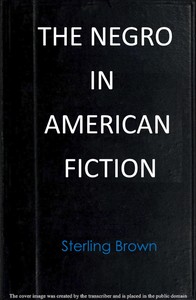
The Negro in American fiction — Story, Setting & Ideas can be approached with a clearer sense of reading commitment from its source measurements: 66,565 words, 4 hr 50 min estimated reading time, and 17 detected text sections.
The text analysis averages about 20.1 words per sentence, while the detected sections provide another way to judge how the source is divided.
Project Gutenberg metadata also associates the work with “African Americans -- Intellectual life,” connecting these edition facts with the source record’s subject description.
Explore this collection
These alternatives are selected using recorded categories and estimated reading time.
About 271 minutes
Historical Psychological Social Fiction
62,291 recorded words. 19 minutes difference from this book's estimate.
View Gutenberg source #2318About 267 minutes
Historical Psychological Social Fiction
61,319 recorded words. 23 minutes difference from this book's estimate.
View Gutenberg source #863About 267 minutes
Historical Psychological Social Fiction
61,282 recorded words. 23 minutes difference from this book's estimate.
View Gutenberg source #1925Search stored excerpts and compare books → Choose by your preferences →
Choices use stored catalog measurements. Estimates vary with reading speed. A shared category is a catalog label, not a claim that two books have the same argument or literary quality.
Search reads excerpt text stored with this catalog and links to its associated Gutenberg record. The connection is stored in the site database; this tool does not recheck that every excerpt is word-for-word identical to that external record. Excerpt search does not cover every chapter and does not verify historical publication dates.
Catalog snapshot checked: 2026-09-25. Coverage: 95 public books, 95 available source excerpts.
Read the complete public-domain text at its original source.
Read on Project GutenbergSterling Brown's The Negro in American Fiction (1937) opens with a blunt premise: the treatment of the Negro in fiction 'parallels his treatment in American life' and has 'naturally been noted for injustice.' The editorial foreword by Alain Locke frames the book as 'the first full-length presentation of this subject,' promising a 'penetrating analysis of the social factors and attitudes behind the various schools and periods.' Brown immediately establishes a critical lens that reads literary depictions as symptoms of broader social exploitation.
The table of contents maps a chronological arc from 'Early Appearances' through 'The Plantation Tradition: Pro-Slavery Fiction' and 'Antislavery Fiction' to later sections like 'Counter-Propaganda—Beginning Realism' and 'Realism and the Folk.' This structure itself tells a story: Brown does not treat literary periods as neutral aesthetic shifts but as responses to political pressures. The early chapters examine how pro-slavery fiction justified exploitation, while antislavery fiction, though oppositional, often relied on sentimental stereotypes. The later sections signal a turn toward more authentic representation, with Brown paying close attention to works that break from the plantation mold.
In the excerpts, Brown's method becomes concrete when he discusses Stephen Crane's 'The Monster' (1897). He notes that Henry Johnson, a Negro hostler, rescues a boy from a fire but is disfigured by acid; initially hailed as a hero, he becomes a 'faceless imbecile' met with 'terror and hatred.' Brown reads the story as 'more a sharp satire of a small town’s intolerance than a study of Negroes,' yet finds 'secondary meanings that pertain to Negro life' in its depiction of 'service, sacrifice, and false affection that goes over into revulsion.' Similarly, he observes that Upton Sinclair's The Jungle (1905) includes Negro characters only incidentally, but draws them 'in grim earnest' as strikebreakers brought from the South, 'surly and dangerous' with knives. Brown's analysis consistently ties literary detail to social function.
A striking pattern emerges in Brown's treatment of how white authors depict Black interiority. Discussing George Kibbe Turner's Hagar's Hoard (1920), he quotes a white narrator's observation: 'All white folks knew was what they generally know about niggers—that bowing and scraping; those brown masks—those faces with all their muscles trained since the sin of Ham... to lie still and show nothing. And those old brown eyes, watching, watching.' Brown does not endorse this view but presents it as a revealing artifact of white perception. The motif of the 'mask' recurs across the excerpts, suggesting a central tension: white authors often acknowledge Black inscrutability without penetrating it. Brown's own critical stance implicitly challenges this limitation.
Brown examines works by white southern women who critique mob violence while sometimes reproducing racial hierarchies. He discusses 'Her Husband' by Mrs. Atwood R. Martin (writing as George Madden Martin), a story about a lynching where the white wife discovers her husband led the mob. Brown notes that the story 'decries the work of agitators upon Negroes' but is 'by no means merely Thomas Nelson Page brought up to date.' He praises its 'sharp protest of an intelligent southern woman against mob-violence' while critiquing its 'unfortunate... connection of heredity with decency.' This balanced treatment—acknowledging progressive intent while identifying residual prejudice—exemplifies Brown's critical approach throughout the book.
Brown organizes his study into twelve chapters plus an introduction, moving chronologically from early appearances to historical fiction. The chapter titles themselves are argumentative: 'The Plantation Tradition: Pro-Slavery Fiction' versus 'Antislavery Fiction'; 'Reconstruction: The Glorious South' versus 'Reconstruction: The Not So Glorious South.' This dialectical structure allows Brown to contrast opposing literary camps while tracing a gradual movement toward realism. The later chapters—'Realism and the Folk,' 'The Urban Scene,' 'Southern Realism,' 'New Roads'—suggest that by the 1930s, some fiction had begun to escape the old stereotypes, though Brown's critical eye remains sharp.
As you read The Negro in American Fiction, pay attention to how Brown moves between summary and analysis. He rarely simply describes a novel; instead, he selects details that reveal the author's social assumptions. Notice how he treats white-authored and Black-authored works differently, and how his own voice as a poet and critic emerges in his choice of adjectives. The book is as much a study of American ideology as of American literature.
Sterling Brown’s way of tracing how a story’s silence can be as telling as its words stayed with me long after I closed it. That quiet unease surfaced again reading Driven from Home, where the gaps in the narrative feel almost deliberate, like shadows holding a truth the author couldn’t quite face. Driven from Home; Or, Carl Crawford's Experience — Text and Context made me wonder how much of that distance was simply the era’s habit.
Your answers remain private and are stored only in this browser.