About 140 minutes
The alien intelligence — Reading Companion
Science Fiction Utopias
32,041 recorded words. 28 minutes difference from this book's estimate.
View Gutenberg source #73724
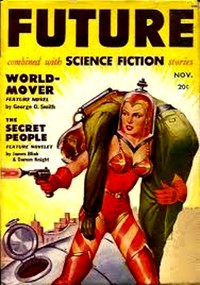
Before opening The world-mover — A Reader’s Guide, the edition data offers a quick orientation: 25,538 words, 1 hr 52 min estimated reading time, and 4 detected text sections.
The text analysis averages about 13.3 words per sentence, while the detected sections provide another way to judge how the source is divided.
Project Gutenberg metadata also associates the work with “Science fiction,” connecting these edition facts with the source record’s subject description.
Explore this collection
These alternatives are selected using recorded categories and estimated reading time.
About 140 minutes
Science Fiction Utopias
32,041 recorded words. 28 minutes difference from this book's estimate.
View Gutenberg source #73724About 77 minutes
Science Fiction Utopias
17,498 recorded words. 35 minutes difference from this book's estimate.
View Gutenberg source #74086About 57 minutes
Science Fiction Utopias
12,977 recorded words. 55 minutes difference from this book's estimate.
View Gutenberg source #61090Search stored excerpts and compare books → Choose by your preferences →
Choices use stored catalog measurements. Estimates vary with reading speed. A shared category is a catalog label, not a claim that two books have the same argument or literary quality.
Search reads excerpt text stored with this catalog and links to its associated Gutenberg record. The connection is stored in the site database; this tool does not recheck that every excerpt is word-for-word identical to that external record. Excerpt search does not cover every chapter and does not verify historical publication dates.
Catalog snapshot checked: 2026-09-25. Coverage: 95 public books, 95 available source excerpts.
Read the complete public-domain text at its original source.
Read on Project GutenbergThe novel opens with physicist Les Ackerman preparing a cyclotron experiment on a new transuranic element called temperon. The description of the setup—deuterium-ice target, neutron bombardment, and the glistening sphere of energy that expands millimeter by millimeter—establishes a recurring visual motif: a strange field of energy that grows slowly until a critical proportion is attained. This image of an expanding, unpredicted sphere becomes a structural anchor, reappearing as the story shifts between worlds.
Smith moves the narrative rapidly from the laboratory to a spaceship where Ackerman finds himself among people from alternate realities. The transition is abrupt, leaving the explosion itself undescribed. Instead, the focus falls on the aftermath: Ackerman’s frustration at being called a “great physicist” and his demand for a lie detector and psychiatrist. The scene underscores a tension between scientific control and chaotic, unexplained forces.
The glistening sphere of energy that appears during the cyclotron experiment is not merely a plot device; it recurs as a structural marker. The text describes it as “a strange field of energy, a true freak of Nature” that hovers at nine centimeters radius before expanding again. This image of gradual, invisible growth mirrors the way the narrative itself expands from a single laboratory accident into a multiverse-spanning conflict. Later, when Ackerman is transported to a ship, the sphere is not mentioned again directly, but its logic—a critical proportion of sample and transmuted nuclei—echoes in the characters’ attempts to understand what happened. The reader is left to connect the physical expansion to the widening scope of the story.
The narrative moves between settings with little transition. One moment Ackerman is in the cyclotron room; the next, he is on a ship with Tod Laplane, Barry Ford, and Joan Laplane. The explosion itself is omitted, creating a gap that forces the reader to infer the event from its consequences. This technique recurs: scenes shift from laboratory to ship to discussion rooms without connective tissue. The effect is disorienting, mirroring Ackerman’s own confusion. Smith uses these jumps to emphasize the discontinuity of Ackerman’s experience—he is “unbelievably alive” and thrust into a situation he does not understand. The reader must piece together the rules of this world alongside the protagonist.
The element temperon is described in precise, technical language. It is stable, but its neutron-isotope is “doubly radioactive,” emitting either an alpha particle or a beta ray. Ackerman explains this to Joan Laplane, who acts as a statistician and recorder. The dialogue about nuclear properties serves a dual purpose: it grounds the science fiction in period-appropriate physics, and it provides a recurring detail that ties together the disparate scenes. The mention of temperon appears in the opening experiment, in the shipboard discussion, and in Ackerman’s later attempts to replicate the accident. This repetition gives the story a sense of continuity despite the fragmented structure.
Ackerman’s voice is marked by irritation and self-deprecation. He snaps at being called a “great physicist” and threatens physical violence if the epithet continues. His demand for a lie detector and scopolamine reveals a man who distrusts his own memory and the motives of others. The other characters respond with laughter that stops abruptly when Ackerman threatens to leave. This interplay of tension and humor defines the group dynamic. Joan Laplane’s “gurgling contralto” and Barry’s mimicry of Ackerman’s voice add texture. The dialogue carries the plot forward while revealing character through tone and reaction.
The novel’s structure—built on expanding spheres, abrupt scene shifts, and recurring technical details—invites the reader to focus on how the narrative is assembled rather than on a straightforward plot. Pay attention to the moments of transition: what is left out often matters as much as what is shown. The dialogue, with its blend of scientific jargon and personal friction, rewards close reading for clues about the rules of the alternate worlds.
The rain drummed on the windowsill while I finished The World-Mover, the expanding spheres still echoing in my mind. It left me with a strange, hollow warmth, a feeling of worlds brushing against each other. Later, I drifted to Boy meets dyevitza — Story, Setting & Ideas, and found a gentler, more personal collision—two people instead of two universes, the same quiet sense of something just out of reach.
Build a private reading journal entry for this title.