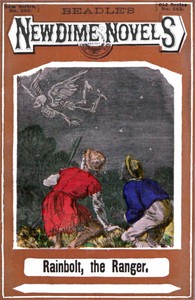
The dime novel Rainbolt, the Ranger; or, The Aerial Demon of the Mountain opens with a chapter titled “The Villains’ Plot,” immediately signaling a world of conspiracy and danger. The title itself promises two central figures: the ranger Rainbolt and the enigmatic “Aerial Demon,” a creature that hovers over the Black Hills landscape. Early chapters introduce the demon as a “horrible, mysterious creature” that floats over an island and disappears down a stream, acting “like a charm on the rebellious robbers.” This blend of frontier adventure and gothic horror sets the tone for a narrative where natural and supernatural threats intertwine.
The Villains’ Plot and the Demon’s Entrance
The first chapter, “The Villains’ Plot,” establishes a conspiracy among robbers in the Black Hills. The catalog subjects list “Brigands and robbers” and “Indians of North America,” but the excerpts focus on the robbers’ schemes rather than Indigenous characters. The “Aerial Demon” is introduced as a creature that terrifies even the hardened criminals, causing them to “rush to their canoe” and flee “fearing to speak above a whisper.” This creature is a recurring presence, appearing at key moments to disrupt the robbers’ plans. The demon’s nature is left ambiguous in the excerpts—whether a man-made device, a trained animal, or something supernatural is not clarified. Readers should note how the demon’s appearances shape the plot and the characters’ reactions.
The Coffin and the Wax Figure
Chapter XIII, “The Meaning of the Coffin,” provides a striking set piece. Frank Armond and Walter Lyman observe robbers burying a small coffin, which they later exhume. Inside, they find “the pale waxen face of a beautiful child” with “flaxen-white hair,” but the Irishman Flick O’Flynn reveals it to be a “trunkless head of a WAX-FIGURE.” The body is unrolled to reveal a leather bag filled with “some hard metal”—likely coins or gold. This scene exemplifies the dime novel’s love of twists: what seems a burial becomes a hiding place for treasure. The robbers’ dialogue, with phrases like “the duty o’ the livin’ to the dead is done,” adds a grim irony. The episode also highlights Flick’s shrewdness, as he insists on digging up the coffin despite objections.
Voice and Structure in the Excerpts
The excerpts reveal a narrative voice that shifts between dramatic description and colloquial dialogue. The robbers speak in dialect: “Do ye s’pose the body’s all right into it?” and “It mout hev got shook around.” The Irishman Flick O’Flynn uses a thick brogue: “Ay, now, and it’s a lovely set of critters they ware.” The prose itself is direct and action-oriented, with short paragraphs and frequent exclamations. Chapters are short—the table of contents lists 24 chapters for a 38,481-word book, averaging about 1,600 words each. This structure keeps the pace brisk, with each chapter ending on a note of suspense or revelation. The use of cliffhangers, such as the demon’s sudden appearance, is a hallmark of the dime novel format.
Setting and Recurring Details
The Black Hills of South Dakota and Wyoming provide the backdrop, with specific locations like “the Devil’s Tarn” and “Lone Pine” mentioned in chapter titles. The landscape is both wild and treacherous: a river island serves as a burial site, and the demon glides “over the island and disappear down the stream.” The robbers’ “ranch” suggests a semi-permanent hideout. Recurring details include the use of canoes for river travel, the robbers’ fear of the demon, and the presence of a “coffin” as a plot device. The excerpts do not show Rainbolt himself in action, but the title and catalog subjects indicate he is the central hero. Readers should watch for how the setting—remote, lawless, and haunted—shapes the characters’ choices.
As you read, pay attention to how the “Aerial Demon” is finally explained in the later chapters—the excerpts leave its nature unresolved. The dime novel’s rapid pacing rewards attention to small details, such as the wax figure’s hair color or the robbers’ dialect. The story’s blend of robbery, kidnapping, and supernatural menace is typical of the genre, but Coomes’s use of a child-sized coffin and hidden treasure adds a distinctive macabre touch. Enjoy the ride through the Black Hills.
Sometimes I think back on Rainbolt’s wax figure in that coffin, how false it felt, and it drifts into a quieter memory of another read. There’s something about crafted dread that lingers, much like the atmosphere in The Monster Maker — Reading Companion—a room that feels watching, not just occupied. I still ponder that peculiar blend of frontier and shadow.