About 119 minutes
Cosmic Saboteur — Story, Setting & Ideas
Adventure Picaresque Fiction
27,257 recorded words. 31 minutes difference from this book's estimate.
View Gutenberg source #66540
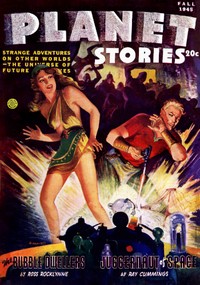
The catalog record for Juggernaut of Space — Themes and Context provides practical reading context through 20,092 words, 1 hr 28 min estimated reading time, and 2 detected text sections.
The text analysis averages about 12.6 words per sentence, while the detected sections provide another way to judge how the source is divided.
Project Gutenberg metadata also associates the work with “Science fiction,” connecting these edition facts with the source record’s subject description.
Explore this collection
These alternatives are selected using recorded categories and estimated reading time.
About 119 minutes
Adventure Picaresque Fiction
27,257 recorded words. 31 minutes difference from this book's estimate.
View Gutenberg source #66540About 55 minutes
Adventure Picaresque Fiction
12,476 recorded words. 33 minutes difference from this book's estimate.
View Gutenberg source #73233About 38 minutes
Adventure Picaresque Fiction
8,633 recorded words. 50 minutes difference from this book's estimate.
View Gutenberg source #62569Search stored excerpts and compare books → Choose by your preferences →
Choices use stored catalog measurements. Estimates vary with reading speed. A shared category is a catalog label, not a claim that two books have the same argument or literary quality.
Search reads excerpt text stored with this catalog and links to its associated Gutenberg record. The connection is stored in the site database; this tool does not recheck that every excerpt is word-for-word identical to that external record. Excerpt search does not cover every chapter and does not verify historical publication dates.
Catalog snapshot checked: 2026-09-25. Coverage: 95 public books, 95 available source excerpts.
Read the complete public-domain text at its original source.
Read on Project GutenbergThe narrator, Robert Rance, introduces himself as a popular-science broadcaster for WANA-NYC, known for the "Crimson Comet" affair. He insists he is no hero, but a "plain American" who gets frightened when his life is in danger. This self-deprecating tone sets the stage for a first-person account that promises "just the facts" rather than a glamorized version. The story begins in August 1985, with a phone call from Dr. Johns of the White Mountains Observatory, whose rumpled hair and bloodshot eyes hint at something ominous.
Rance's opening remarks establish a deliberate contrast between public perception and private reality. He claims the publicity from the Crimson Comet incident is unwanted, and he writes to correct the record. This framing invites readers to question the reliability of the account: is Rance truly modest, or is he shaping his narrative to appear humble? The text shows him struggling for personal publicity before the adventure, then rejecting it afterward. The excerpts do not reveal whether his version differs substantially from the "professionally glamorized" one, but the tension between self-deprecation and self-justification is evident.
The Radaks are described with specific physical traits: "squat little" figures with "greenish eye-beams" in a "crimson gloom." When Blaine stabs one, the knife goes in "with a crunch, a rasp as it severed the strange flesh," and "hot fluid spurted." These details emphasize the alienness of the adversaries, blending mechanical and organic qualities. The Radaks' "machine-like strength" and the description of their "strange flesh" suggest a hybrid nature. The combat scene relies on a "cylinder" weapon that freezes targets, but its limitations are shown when Blaine misses and must resort to a knife. The excerpts do not explain the cylinder's full capabilities or origin.
The environment is consistently described in terms of color and confinement: "crimson upper surface," "crimson gloom," and "cave-cell." The Radaks' corridors are "narrow" and "winding," with branching passages that create a labyrinthine feel. The surface is populated by "crimson monsters" that stalk the characters. The excerpts give no indication of the asteroid's size, origin, or purpose beyond being a prison. The setting functions primarily as a threatening backdrop, with the color red dominating visual descriptions. The lack of any natural light or landscape details keeps the focus on the immediate danger.
Readers should note that the excerpts cover only the opening and a mid-story action sequence, leaving the overall plot structure and resolution unknown. The narrative voice is consistent in its self-deprecating tone, but whether Rance's account remains reliable throughout is an open question. Pay attention to how the scientific elements (broadcasting, observatory) are used to ground the fantastic events, and how the Radaks' society or motives are revealed—if at all—in the full text.
Folks forget how alone a voice can feel in the dark. Juggernaut of Space has that broadcaster, Rance, adrift among cold green beams, whispering his story to anyone who might listen. It reminds me of another lonely whisper—the one beneath a church’s shadow, waiting for a curious mind to find it. The haunter of the dark — Edition Insights holds that same hush, a patient echo between covers.
Save your reaction, strongest insight, and memorable passage.