About 208 minutes
Joe the Hotel Boy; Or, Winning out by Pluck — Reading Notes
Adventure Picaresque Fiction
47,803 recorded words. 11 minutes difference from this book's estimate.
View Gutenberg source #528
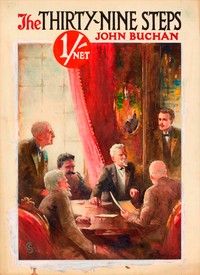
The Thirty-Nine Steps — Story, Setting & Ideas can be approached with a clearer sense of reading commitment from its source measurements: 45,215 words, 3 hr 17 min estimated reading time, and 12 detected text sections.
The text analysis averages about 16.6 words per sentence, while the detected sections provide another way to judge how the source is divided.
Project Gutenberg metadata also associates the work with “World War, 1914-1918 -- Fiction,” connecting these edition facts with the source record’s subject description.
Explore this collection
These alternatives are selected using recorded categories and estimated reading time.
About 208 minutes
Adventure Picaresque Fiction
47,803 recorded words. 11 minutes difference from this book's estimate.
View Gutenberg source #528About 168 minutes
Adventure Picaresque Fiction
38,481 recorded words. 29 minutes difference from this book's estimate.
View Gutenberg source #59847About 156 minutes
Adventure Picaresque Fiction
35,680 recorded words. 41 minutes difference from this book's estimate.
View Gutenberg source #69323Search stored excerpts and compare books → Choose by your preferences →
Choices use stored catalog measurements. Estimates vary with reading speed. A shared category is a catalog label, not a claim that two books have the same argument or literary quality.
Search reads excerpt text stored with this catalog and links to its associated Gutenberg record. The connection is stored in the site database; this tool does not recheck that every excerpt is word-for-word identical to that external record. Excerpt search does not cover every chapter and does not verify historical publication dates.
Catalog snapshot checked: 2026-09-25. Coverage: 95 public books, 95 available source excerpts.
Read the complete public-domain text at its original source.
Read on Project GutenbergJohn Buchan’s The Thirty-Nine Steps opens with a narrator who is thoroughly disgruntled: Richard Hannay, returned from South Africa, finds London “as flat as soda-water that has been standing in the sun.” The voice is immediate, colloquial, and self-aware—Hannay addresses himself by name and measures his own boredom against the plans he had built “those last years in Buluwayo.” This direct, slightly sardonic tone sets the pace for a story that Buchan, in his dedication, calls a “shocker,” a romance where incidents “march just inside the borders of the possible.” The author’s preface is worth noting: it frames the book as a deliberate exercise in improbable adventure, written during an illness to supply “aids to cheerfulness.”
From the first paragraph, Hannay’s narration establishes a rhythm of impatience and self-mockery. He tells himself, “you have got into the wrong ditch, my friend, and you had better climb out.” The second-person address within a first-person narrative creates an intimacy that Buchan sustains throughout the excerpts. Hannay’s complaints are concrete—weather, talk, lack of exercise—and his frustration is physical: “yawning my head off all day.” This restlessness becomes the engine of the plot. When the murdered man Scudder appears, Hannay’s boredom is replaced by a hunted alertness, but the voice retains its clipped, practical quality. Buchan avoids interior monologue; instead, Hannay reports actions and observations in short, declarative sentences. The effect is a narrative that feels breathless, as if the reader is running alongside the speaker.
Buchan uses dialogue not only to advance the chase but to reveal character through verbal performance. In the encounter with the enemy master, Hannay adopts the persona of “Ned Ainslie,” a down-on-his-luck sailor. His speech shifts to a “real beggar’s whine,” and he invents a story about an Archangel ship and a broken motor-car. The dialogue is layered: Hannay speaks one way to his captor while the reader knows his true identity. The enemy tests him with a sudden switch to German, but Hannay’s face remains “as blank as a stone wall.” This moment of linguistic deception underscores the cat-and-mouse structure. Buchan also uses dialogue to plant clues—Scudder’s phrase about a man who “could hood his eyes like a hawk” recurs when Hannay notices the master’s eyelids “tremble and fall a little.” The repetition ties spoken warning to visual proof.
Buchan’s descriptions are economical but precise, grounding the improbable chase in tangible details. Hannay notes the loss of his “coat and waistcoat” during an escape, and later he is “lacking coat and waistcoat and collar” when confronted by the enemy. These small, repeated wardrobe details anchor the narrative in physical reality. The setting shifts from London flats to Scottish hills, but Buchan rarely lingers on scenery; instead, he uses landscape as an obstacle or hiding place. The “hole in a hedge” through which Hannay spots a motor-car, the “burn” where he washes his face, the “hill” the police are convinced he crossed—each detail serves the plot. The enemy’s house is introduced through a single sensory cue: the smell of bacon and eggs that makes Hannay’s mouth water before the door opens. This focus on immediate, bodily experience keeps the story grounded even as the coincidences multiply.
Buchan’s dedication to his friend Thomas Arthur Nelson openly acknowledges the genre’s defiance of probability. He calls the book a “shocker” where incidents “defy the probabilities” and “march just inside the borders of the possible.” This framing is not an apology but a declaration of intent. The excerpts bear this out: Hannay escapes by luck, disguises himself on the fly, and stumbles into the enemy’s headquarters by chance. The enemy master, despite his suspicion, is momentarily fooled by Hannay’s improvised story about a motor-car wreck. Buchan does not pretend realism; instead, he relies on the momentum of Hannay’s voice and the rapid succession of events to carry the reader. The result is a narrative that feels like a game—one in which the rules are set by the author’s willingness to push coincidence to its limit without breaking the spell.
Readers approaching The Thirty-Nine Steps will find a story that moves at a headlong pace, driven by Hannay’s restless narration and Buchan’s lean prose. The book rewards attention to small verbal cues—a repeated phrase, a change in dialect, a missing coat—that build the texture of the chase. Because the excerpts cover only the opening chapters, the later development of the “Black Stone” conspiracy and the titular steps remains unknown. The pleasure lies in watching Hannay talk his way out of corners, and in Buchan’s craft of making the improbable feel, for a few pages, entirely plausible.
Reading Buchan’s preface about his “shocker,” I caught myself smiling at how his restless London felt like a preamble to those open seas. The same breathless pull—a man alone, trusting his legs and wits—lives in Stevenson’s pages, though there the salt spray replaces moorland fog. Funny how distant boys’ games echo each other across decades. Treasure Island — A Closer Reading brings that old feeling back, quiet as a tide.
Answer a few questions and save a private reflection on this device.