About 351 minutes
Frank Merriwell's Marriage; Or, Inza's Happiest Day — Reading Companion
Adventure Picaresque Fiction
80,669 recorded words. 2 minutes difference from this book's estimate.
View Gutenberg source #62072
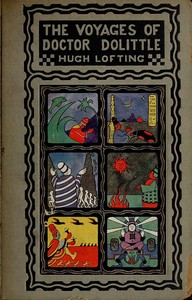
The source record for The Voyages of Doctor Dolittle — A Reader’s Guide measures this digital text at 80,245 words, 5 hr 49 min estimated reading time, and 67 detected text sections.
The text analysis averages about 15.9 words per sentence, while the detected sections provide another way to judge how the source is divided.
Project Gutenberg metadata also associates the work with “Fantasy literature,” connecting these edition facts with the source record’s subject description.
Explore this collection
These alternatives are selected using recorded categories and estimated reading time.
About 351 minutes
Adventure Picaresque Fiction
80,669 recorded words. 2 minutes difference from this book's estimate.
View Gutenberg source #62072About 323 minutes
Adventure Picaresque Fiction
74,090 recorded words. 26 minutes difference from this book's estimate.
View Gutenberg source #69191About 321 minutes
Adventure Picaresque Fiction
73,685 recorded words. 28 minutes difference from this book's estimate.
View Gutenberg source #120Search stored excerpts and compare books → Choose by your preferences →
Choices use stored catalog measurements. Estimates vary with reading speed. A shared category is a catalog label, not a claim that two books have the same argument or literary quality.
Search reads excerpt text stored with this catalog and links to its associated Gutenberg record. The connection is stored in the site database; this tool does not recheck that every excerpt is word-for-word identical to that external record. Excerpt search does not cover every chapter and does not verify historical publication dates.
Catalog snapshot checked: 2026-09-25. Coverage: 95 public books, 95 available source excerpts.
Read the complete public-domain text at its original source.
Read on Project GutenbergThe narrative structure of The Voyages of Doctor Dolittle is built around a series of distinct episodes, each introduced by chapter headings that read like a table of contents for an adventure serial. The story moves from the domestic setting of Puddleby-on-the-Marsh to the floating island of Spidermonkey Island, with each leg of the journey introducing new challenges and characters. Lofting uses the first-person perspective of young Tommy Stubbins to ground the fantastical events in a relatable, observant voice.
The excerpts reveal a pattern of rapid scene shifts: from the Doctor's home to a bullring in Monteverde, then to a shipwreck, and finally to a floating island. These transitions are often abrupt, emphasizing the picaresque nature of the tale. The recurring image of the Doctor's parrot, Polynesia, as a strategist and translator, provides continuity across disparate settings.
The table of contents itself functions as a map of the book's episodic rhythm. Part One, for instance, moves from “The Cobbler’s Son” through “I Become a Doctor’s Assistant” in fifteen chapters, each a self-contained vignette. Later parts, such as Part Five, include headings like “Fire,” “War!,” and “The Coronation of King Jong,” which read like a sequence of dramatic set pieces. This structure allows Lofting to introduce new characters and crises without requiring a tightly woven plot. The chapters are short, often ending on a note of suspense or discovery, encouraging the reader to continue. The excerpt from the bullfight episode shows how a single chapter can contain a complete arc: the wager, the victory, the escape, and the aftermath. This episodic quality is typical of adventure fiction aimed at younger readers, but Lofting’s use of detailed chapter titles also gives the book a mock-heroic flavor, as if each event is a notable exploit.
Polynesia, the Doctor’s parrot, appears in the excerpts as a recurring figure who not only translates but also orchestrates events. In the bullfight episode, she directs Tommy and Bumpo to collect jewelry and collect bets, saying, “Run along—and not a word to the Doctor, remember.” This image of the parrot as a shrewd, pragmatic manager recurs throughout the text. Another recurring motif is the pocket or bag used to carry money and trinkets. Bumpo’s “pockets bulging in all directions” after collecting the bullfight winnings echoes earlier scenes where the Doctor’s home is filled with animal-related clutter. These small, concrete details—the parrot’s commands, the bulging pockets—ground the fantastical adventures in a tactile reality. The image of Polynesia flying onto the Doctor’s shoulder after a victory reinforces her role as a link between the animal and human worlds.
The excerpts demonstrate a characteristic pattern of rapid, often chaotic movement between settings. In the bullfight episode, the action shifts from the ring to the crowd, to the matadors’ dressing-room, to a grocer’s shop, and finally to the harbor—all within a few pages. The transitions are marked by urgency: “As soon as the Doctor had departed Bumpo sought out Don Enrique,” and “We next set out to buy the provisions.” Lofting uses short paragraphs and dialogue to accelerate the pace. The escape sequence is particularly vivid: “Bumpo snatched up a big beam of wood… letting out dreadful African battle-yells.” This movement is not merely geographical but also tonal, shifting from the triumph of the bullfight to the danger of the mob. The recurring phrase “we didn’t waste any time” underscores the constant forward momentum. The ship, “The Curlew,” serves as a base that the characters repeatedly return to, providing a structural anchor amid the episodic chaos.
Throughout the excerpts, money and trade are recurring practical concerns. In the bullfight episode, Polynesia’s first thought after victory is to collect “trinkets” and “rings” to pawn, and Bumpo insists on collecting his bet of three thousand pesetas. The characters are constantly calculating fares, buying provisions, and hiding their wealth from the Doctor. This focus on economics gives the adventures a grounded, almost mercantile quality. The Doctor himself seems indifferent to money, but his companions are not. The line “We might as well lay in a good supply of money while we’ve got the chance” reflects a pragmatic survival instinct. This motif recurs in other episodes: the need to buy food, pay for passage, or bribe officials. It contrasts with the more idealistic aspects of the story, such as the Doctor’s desire to learn animal languages. The tension between adventure and commerce adds a layer of realism to the fantastical voyages.
Readers will find that the book’s pleasures lie less in a single overarching plot than in the accumulation of vivid, self-contained episodes. Pay attention to the chapter headings, which often hint at the tone of what follows, and to the recurring role of Polynesia as a voice of practical wisdom. The movement between scenes is swift and often chaotic, reflecting the picaresque tradition. The excerpts suggest that the story rewards a focus on small, concrete details—the weight of a pocketful of coins, the sound of a parrot’s command—rather than on grand themes.
There’s a moment in The Voyages of Doctor Dolittle where Tommy realizes that Captain Bumpo’s fascination with fairy tales isn’t childishness but a kind of longing—for a story grander than his own shore-lined days. It reminded me, gently, of another wandering man chasing impossible promises, and how that pursuit can feel braver than staying put. I think of Don Quixote — Inside the Classic sometimes, the same way I’d recall an old friend’s funny, stubborn heart. Different oceans, same star.
Your answers remain private and are stored only in this browser.